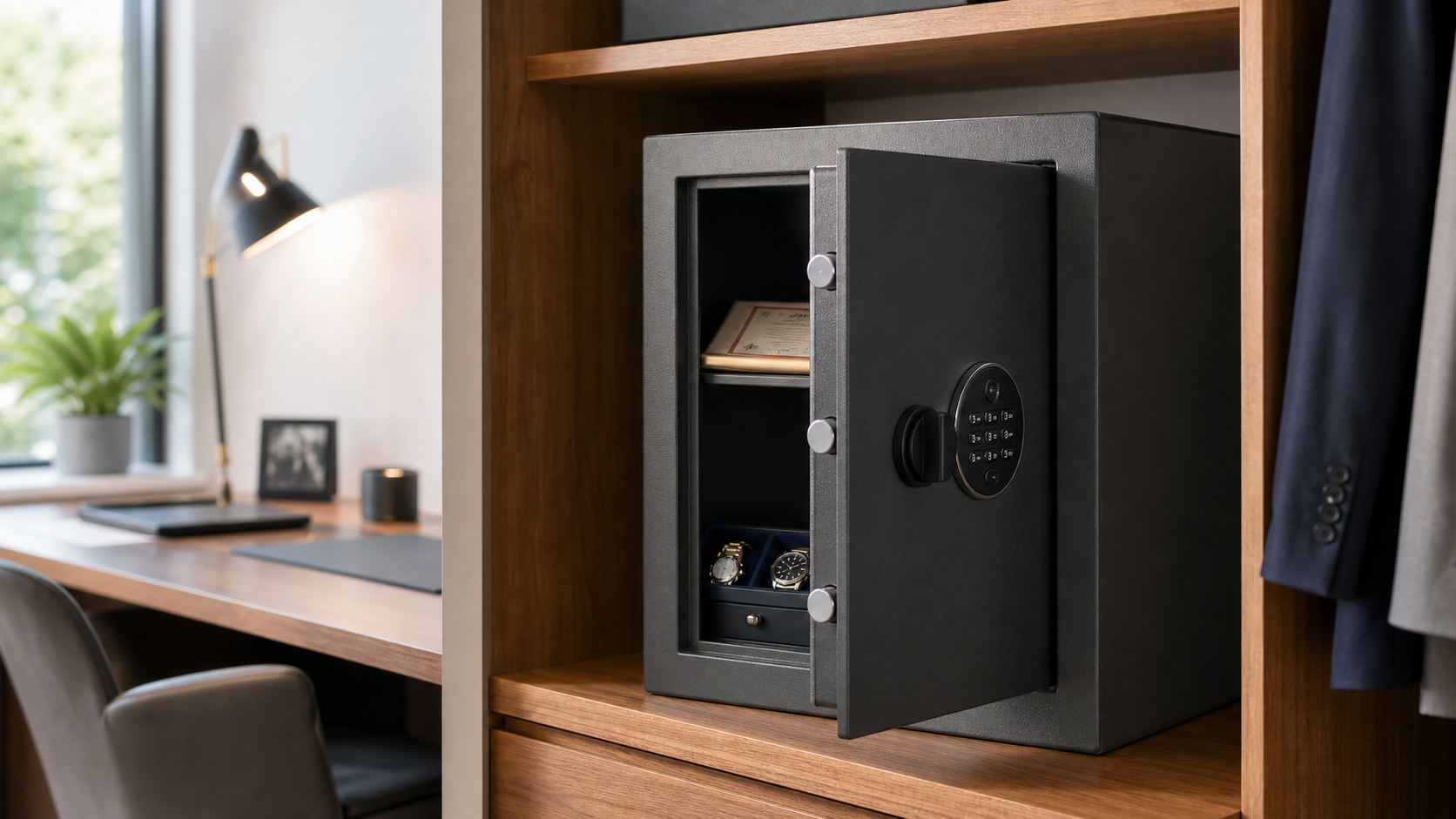


Choosing a safe gets confusing fast: obscure ratings (UL RSC, TL-15, fire ratings), burglary vs. fire protection, freestanding or anchored, key, keypad or biometric lock. You can end up buying a sheet-metal box that feels reassuring but protects nothing.
In fifteen years, I've seen plenty of big-box-store safes walk out whole under burglars' arms. My takeaway is simple: a safe is only as good as its rating and its anchoring. An unanchored safe is just a suitcase with a lock.
This hub is your starting point. Below you'll find a quick way to identify your profile, my top 3 by use case, the ratings that truly matter, and how to anchor and size a safe — then a link to the full hands-on comparison when you're ready to choose.
Which safe is right for you?
Before comparing models, identify your profile. Most households fall into one of these three.
Documents & keepsakes
Your main risk is fire and water. Prioritize a UL 72 fire-rated safe for papers, passports, drives and photos.
Convenience first
You want fast, daily access. A biometric/smart safe (fingerprint + app) for jewelry, cash or a firearm — bolted down securely.
Significant valuables
You're insuring jewelry, watches or cash. Aim for a UL RSC (or TL-rated) safe, anchored or built in.
Our top 3 safes by profile
No time to compare every model? Here are the three picks that cover the vast majority of needs, rated by our editorial team.
SentrySafe SFW205GQC
- ✅ UL-rated fire resistance
- ✅ Protects documents, drives, keepsakes
- ⚠️ Heavier and bulkier
Vaultek RS500i Biometric
- ✅ Biometric + keypad + key opening
- ✅ Good capacity, anchoring hardware included
- ⚠️ Burglary-resistant but not UL TL-rated
Honeywell 1104
- ✅ Excellent value
- ✅ Compact, keypad + backup key
- ⚠️ Must be bolted down (lightweight)
The different types of safes
Two factors shape the choice: how it's installed and the type of lock.
Freestanding (bolt-down)
The most common type. Bolts to the floor or wall. Simple and versatile — as long as you anchor it properly.
In-wall / built-in
Set into a load-bearing wall, hidden behind a picture or furniture. Very discreet, more involved to install.
Fireproof
Designed to resist fire (documents, digital media). Often bulkier for the same level of protection.
On the lock side, you'll choose between key (simple but losable), electronic keypad (changeable code, backup key), biometric (fingerprint) and smart (app, access log).
Burglary vs. fire ratings: the decisive factor
This is where it all comes down. A safe without a recognized rating offers no serious guarantee. The two protections are distinct.
✅ Burglary resistance
- UL RSC: the baseline burglary rating (Residential Security Container)
- UL TL-15 / TL-30: higher grades, recognized by insurers for high-value contents
- Aim for these for jewelry, watches, cash
🔥 Fire resistance
- UL 72 or ETL fire ratings (duration + media type)
- Paper ≠ digital media (different temperature limits)
- Aim for these for documents, hard drives, keepsakes
To protect against both theft and fire, choose a dual-rated safe (UL RSC burglary + UL 72 fire).
Anchoring and sizing
I'll say it again because it's crucial: an unanchored safe protects nothing.
- To the floor in a concrete slab: the strongest anchoring.
- To a load-bearing wall: handy for wall-mount models.
- Built-in / set into the wall: maximum discretion and resistance, installed by a pro.
- Discreet location: avoid the master bedroom, the first room searched.
For sizing, about 0.7–1.4 cubic feet covers most household needs — but list what you'll store and plan for extra room.
Complete guide: how to choose a home safe Ratings, sizing, anchoring and placement: all the details to get it right.The best home safes of 2026 at a glance
Here's a synthetic overview of our top picks. For full ratings, pros/cons, pricing and our testing notes on all 5 models, head to the complete comparison.
| Safe | Rating | Best for |
|---|---|---|
| SentrySafe SFW205GQC | ★★★★★ 4.8 | Documents, keepsakes |
| Vaultek RS500i Biometric | ★★★★★ 4.7 | Versatile, convenient |
| First Alert 2096DF Waterproof | ★★★★☆ 4.4 | Flood-prone areas |
| Honeywell 1104 | ★★★★☆ 4.3 | Budget, compact |
| Stack-On PS-514 | ★★★★☆ 4.1 | Larger capacity |

Frequently Asked Questions about home safes
These are two distinct protections. Burglary resistance is measured by the UL RSC rating (and higher TL-15 / TL-30 grades); fire resistance by UL 72 or ETL fire ratings (rated in hours at a given temperature). For jewelry and cash, prioritize burglary resistance; for documents, hard drives and keepsakes, fire resistance. For both, choose a dual-rated safe.
Yes — it's the single most important step. An unanchored safe under 400 lbs walks out the door under a burglar's arm, to be opened later at their leisure. Bolt it to a concrete slab or a load-bearing wall, in a discreet spot (never the master bedroom). Anchoring is 80% of the protection.
Not the safe itself, but its contents: most insurers tie coverage of valuables (jewelry, cash) above a certain limit to the presence of a rated, bolted-down or anchored safe. A UL RSC burglary-rated safe often raises your covered limit for valuables. Check the exact requirements of your policy before buying.
In a discreet, hard-to-reach spot: never in the master bedroom (the first room burglars search), but rather in a load-bearing wall, a utility closet, the garage or a closet. The key is to bolt it down or anchor it: an unsecured safe under 400 lbs walks out the door with the burglar.
List what you want to store and plan for extra room — you always fill a safe faster than expected. About 0.7–1.4 cubic feet covers most household needs (documents, jewelry, a couple of drives). Go bigger if you're storing binders, cameras or a firearm.
Ready to choose?
Compare all the tested models in detail, or read our complete buying guide.
Explore the safes section
Everything you need to choose, anchor and insure the right safe.