America's #1 home security resource 100% free advice
Compare the best safes for your home in New York, and learn how to anchor them properly — yourself or with a pro in NY.
For a home in New York, a smart safe should above all be bolted down and matched to the value of what you're protecting. Models with an access log, mobile alerts and a mechanical key override strike the best balance for family use.
A safe only truly protects if it's well chosen and properly anchored. Here's first what you need to know about the real risk in New York and across NY.
New York City is the most populous city in the United States, home to more than 8 million residents. Its extreme density and around-the-clock activity make burglary prevention a priority, especially in walk-up buildings and ground-floor units. New Yorkers overwhelmingly choose wireless, no-drill alarm systems suited to apartments and co-ops.
In short: The NYPD records tens of thousands of burglaries and grand larcenies each year, concentrated in buildings with shared entries and easily reached fire escapes.
Source: FBI Crime Data Explorer (UCR) & Bureau of Justice Statistics — 2023 data.
| Category | NY rate | US avg. | Diff. |
|---|---|---|---|
| Burglaries | 1.60 | 3.00 | -47% |
| Aggravated assaults | 2.40 | 2.70 | -11% |
| Home invasions | 0.90 | 1.00 | -10% |
| Vehicle thefts | 1.70 | 3.00 | -43% |
| Larceny / theft | 9.30 | 13.00 | -28% |
Compare New York with another state using our interactive tool
New York is dominated by multi-unit housing: about 19 of every 20 homes are apartments, condos or co-ops. Ground-floor units, apartments near fire escapes, and buildings with shared lobbies see the bulk of break-ins, often through a forced unit door in under two minutes. The large share of pieds-à-terre and frequently empty units — especially in Manhattan — creates long stretches of vacancy that burglars learn to spot.
Housing type: Dense urban (apartments dominate)
Main residential neighborhoods: Upper East Side · Park Slope · Forest Hills · Riverdale · Bay Ridge · Astoria
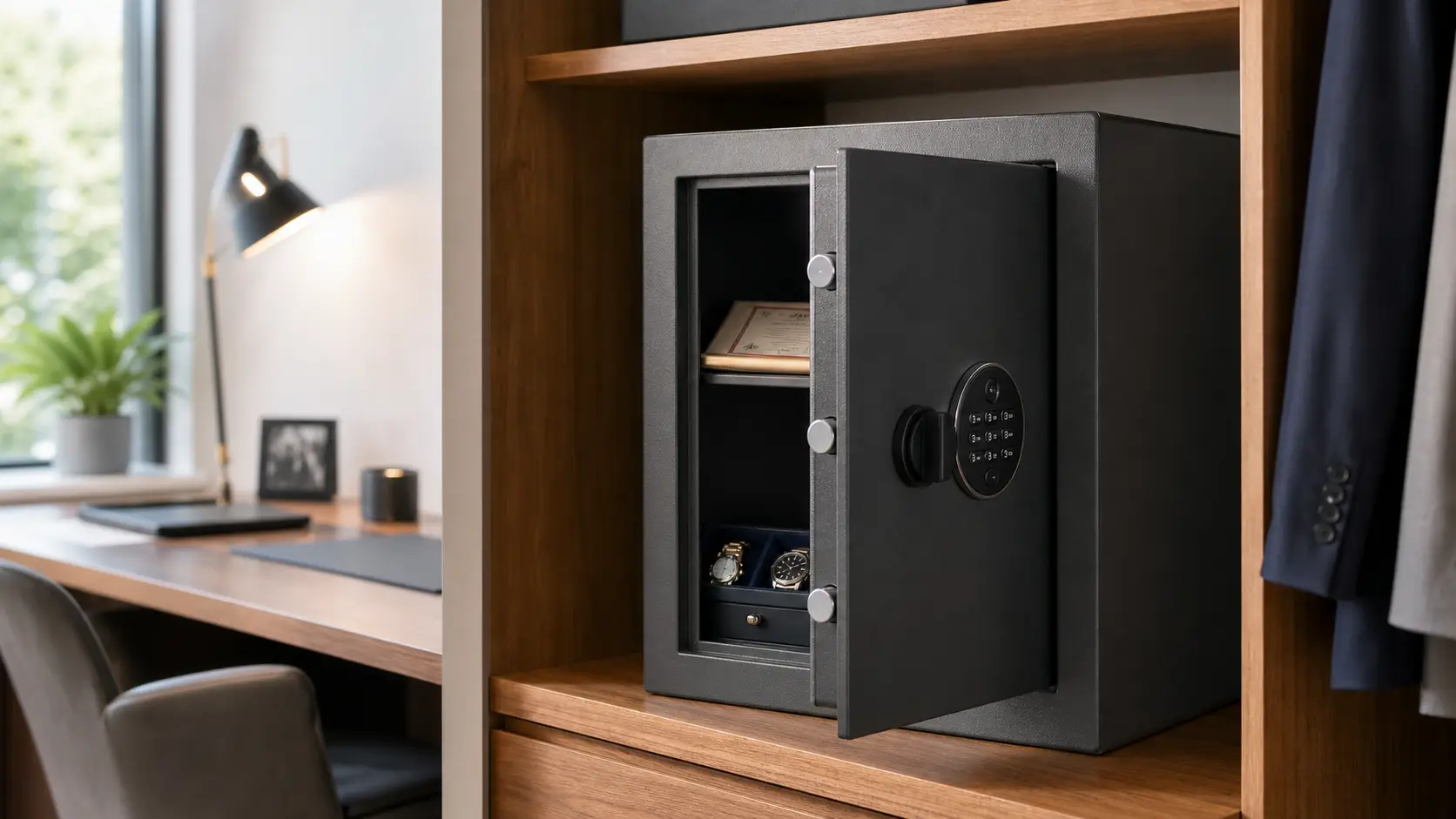
Three reliable picks for your needs — from the biometric safe with mobile alerts to the fireproof model for documents, down to the compact budget option.
| Safe | Rating | Best for | Action |
|---|---|---|---|
| Vaultek RS500i Biometric Smart | Smartphone alerts, tracked openings | Amazon≈ $250–350 | |
| SentrySafe SFW205GQC Fireproof | Fire + theft protection, documents and papers | Amazon≈ $280–380 | |
| Honeywell 1104 Compact | Tight budget, quick security | Amazon≈ $100–160 |
To insure valuables, first check the burglary rating (UL RSC, or TL-15/TL-30) required by your insurer, then the usable capacity and the anchoring method.
Heavy safe or anchoring into concrete? A professional guarantees an anchor that resists prying. Request a free quote for installation in New York →
Any alarm triggered by a break-in or attempted break-in should be reported to police as soon as possible — a police report number is almost always required for your homeowners or renters insurance theft claim.
NYPD — your local precinct handles non-emergency reports (find it at nyc.gov/nypd)
311 (non-emergency) or 911 (emergency)
Jurisdiction: New York City Police Department (NYPD)
Many departments offer a free vacation house check program: register an extended absence in New York and patrol officers will keep an eye on your home while you're away. Contact your local precinct to enroll.
For valuables (jewelry, cash, watches), most insurers tie coverage above a certain limit to a rated safe (UL RSC burglary rating, or higher TL-15/TL-30 grades) that's bolted down. Below the limit, a basic safe is enough. Check the "valuables" and "scheduled items" clauses of your homeowners or renters policy before buying.
The principle: an unanchored safe gets carried off under one arm. Bolt it into a load-bearing wall or a concrete slab, in a discreet room — never the master bedroom, the first place burglars search. A closet, a garage wall or a utility floor make better hiding spots. The heavier and more firmly anchored the safe, the less it interests a rushed burglar.
For a small safe in a wall cavity, you can do it yourself. But for a heavy model, a floor anchor or a concrete anchor (chemical anchors), a professional guarantees a hold that truly resists prying — which is the whole point of the safe. A botched anchor cancels out the protection.
It depends on your policy and the safe's rating. Check your insurer's requirements, especially around anchoring and fire/burglary ratings (UL RSC, fire rating).
Put it somewhere discreet, bolted to a wall stud or the floor, away from obvious rooms like the entryway or the primary bedroom.
Serious models include a backup power option, a mechanical override key or external contacts so you can safely unlock the safe.
Yes — most smart safes still open by code, key or biometrics even with no internet connection.
To go further based on your situation, these guides complement this safes page for New York.