

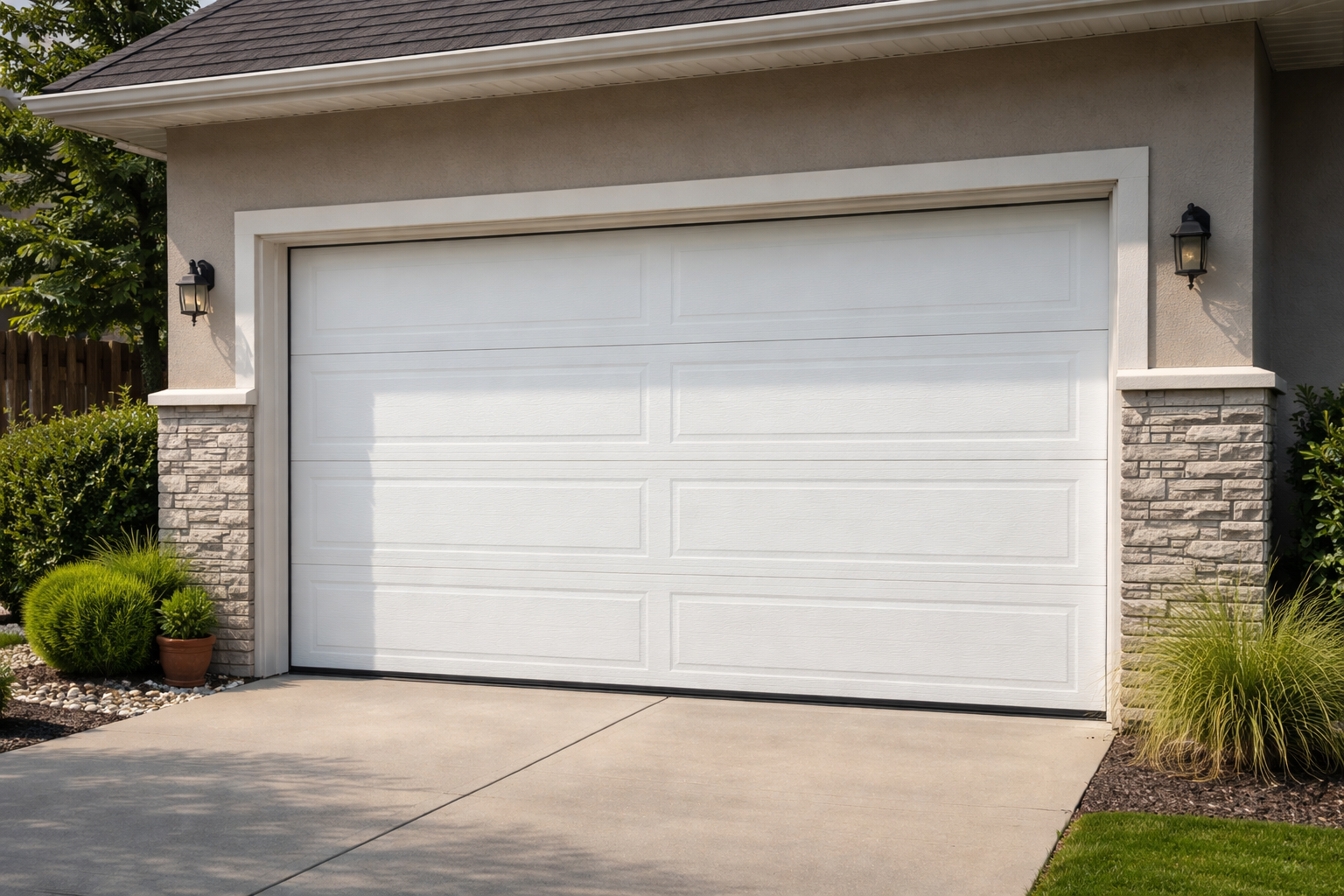
Securing your garage: doors, locks, alarms and cameras to protect vehicles, tools and the direct access to your home. This guide sums up the criteria that matter, the mistakes to avoid and the concrete choices that help you decide faster.
The garage is one of the most vulnerable entry points in the house — and one of the most neglected. People invest in a beautiful garage door… while leaving the door that leads into the house made of hollow plywood.
In fifteen years of inspections, I’ve seen the garage serve as a highway into the rest of the home: once inside, the burglar works out of sight, with your own tools, and often gets straight into the house. Here’s how to cut off that highway, step by step.
Why the garage is a priority target
The garage draws burglars for very concrete reasons: they can work out of sight, the doors are often made of lightweight material, old remotes can be cloned with a $30 device, your tools are right there to force the next door, and it stores valuables (car, bikes, power tools). According to FBI burglary data, outbuildings and attached structures account for a heavy share of residential break-ins.
Garage door types and their weaknesses
| Door type | Native security | Weak point | Average cost |
|---|---|---|---|
| Tilt-up (one-piece) | ⭐⭐ | Easy to lift, 1 point | $300–$800 |
| Sectional | ⭐⭐⭐ | Remote hacking | $800–$2,000 |
| Roll-up | ⭐⭐ | Thin curtain, can be unhooked | $600–$1,500 |
| Swing / carriage | ⭐ | 2 panels, basic lock | $400–$1,200 |
The motorized sectional with rolling code stays the best security/convenience balance.
Is your garage an easy target?
Before the solutions, run the diagnostic — it’s the walkthrough I do when I arrive at a client’s home.
🚗 Is your garage an easy target?
6 questions, 1 minute. The result will tell you where to start.
1. Your garage door is…
2. The door between the garage and the house is…
3. Do you have an extra lock on the door?
4. Is the garage lit / sensed at night?
5. An alarm or camera in the garage?
6. Does the remote stay in the car parked outside?
Solution 1 — reinforce the garage door
Three levers, from the simplest to the heaviest.
A high-grade lock (deadbolt or multi-point): multiplies the resistance of a tilt-up or swing door locked at a single point. Budget $80–$300 + install. Anti-lift bar, slide bolts, padlock in the track: the cheapest DIY counter ($15–$80) and a formidable one.
If your opener is more than 10 years old, it probably uses a fixed code that can be cloned: upgrade to a recent rolling-code opener ($300–$800).
✅ Reinforce what you have
- Affordable (bolts from $50), DIY, immediate
- Enough if the door is in good shape
⚠️ Replace the door / opener
- Maximum security (sectional rolling code)
- But a heavy investment and a pro install
Solution 2 — the connecting door (the absolute priority)
This is the most critical point if the garage is attached. This door must be treated like a front door.
The right level: a solid-core steel door (or fire-rated steel), a Grade 1 deadbolt with a high-security cylinder, anti-removal hinges. The principles are detailed in our guide to securing your front door — they apply here exactly as written.
Solution 3 — alarm and detection
Detect the intrusion before the house is reached. The winning combo: an entry sensor ($15–$40) that chimes the moment the door moves, a motion detector ($20–$80), and a visible outdoor siren. Ideally tie it to your main alarm system rather than piling up isolated boxes.
Three things people forget. One: if you store things in the garage and go in regularly, get a “pet-immune” motion detector to avoid false alarms (temperature swings, pets). Two: on a tilt-up or sectional door, put the contact sensor on the moving panel, not the frame — it’s the door’s movement you want to detect, not the lock. Three: for a detached garage with no alarm in the house, choose a standalone kit with a built-in siren and a SIM/cellular module, which alerts your phone even if the garage is 100 ft from the living room. A siren screaming in an isolated garage that nobody hears is useless.
Solution 4 — security camera
An indoor camera deters and provides evidence. Aim for 1080p min (2K ideal), night vision (the garage is dark), a wide angle and local storage. Place it high (8–10 ft) to cover both the garage door and the connecting door. All the criteria are in our security cameras guide.
Two practical questions settle 90% of cases. Power: a garage almost always has an outlet — prefer a wired or plug-in camera, more reliable than a battery camera you forget to recharge. Network: if the garage is detached, the house Wi-Fi often doesn’t reach it. Two solutions — a Wi-Fi extender / powerline adapter to extend the network, or a standalone cellular (4G/LTE) camera with its own SIM. For storage, prefer a local microSD card (or an NVR), which keeps recording even if a burglar cuts the internet, over cloud-only.
Solution 5 — motion-sensor lighting
The most economical measure and one of the most effective: a burglar avoids the light. A motion-sensor LED floodlight ($25–$80) in front of the door, a motion-sensor bulb inside. For choosing and placement, see our guide on motion-sensor security lighting.
Two settings make the difference. Aim the sensor so it sweeps the approach zone (driveway, the side of the door) and not the street — otherwise it triggers on every passerby and you end up unplugging it. And for a detached garage with no electrical supply, a solar motion-sensor floodlight installs in ten minutes with no trenching or electrician: the cell charges during the day, the light triggers at night. The ideal is the “low constant night-light + full beam on detection” mode: the area is never totally dark, and the sudden glare clearly signals that someone has been spotted.
Protect the contents (and the remote)
The garage often holds thousands of dollars of gear. Anchor bikes and e-bikes to a fixed, bolted-down point, lock up your power tools, and secure your ladder and step stool (they give access to upper floors).
Summary: budget and priorities
| Solution | Budget | Effectiveness | Install |
|---|---|---|---|
| Reinforced connecting door | $500–$1,500 | ⭐⭐⭐⭐⭐ | Pro |
| Motion-sensor lighting | $25–$80 | ⭐⭐⭐⭐ | DIY |
| Bolts / bar / padlock | $50–$150 | ⭐⭐⭐ | DIY |
| Detection + siren | $80–$300 | ⭐⭐⭐⭐ | Easy |
| Camera | $60–$200 | ⭐⭐⭐⭐ | DIY |
| High-grade lock / opener | $200–$800 | ⭐⭐⭐⭐ | Pro |
On a tight budget, prioritize the connecting door (if attached) + a motion-sensor floodlight: the best cost/effectiveness ratio. Solid budget: $500–$1,000; full setup: $1,500–$3,000.
Common mistakes
- Reinforcing the garage door and forgetting the connecting door: the classic mistake, which opens the house.
- Keeping a fixed-code opener more than 10 years old: cloned in seconds.
- Leaving the remote in the car parked outside.
- Storing a ladder and tools within reach of an intruder.
- A garage in the dark: no deterrence, no detection.
They secured their garage
Composite stories (fictional first names) built from common cases.
Pascal — “They came in through the garage, not the house.” His front door was reinforced, but his tilt-up door led to a wood connecting door. “They lifted the tilt-up, and the door into the house didn’t hold. All my fancy front door was useless.” He has since fitted a steel connecting door with a Grade 1 deadbolt and an anti-lift bar.
Sonia — “The remote in the car, a mistake I’ll never make again.” “They broke into the car for the paperwork, found the remote, and the garage opened on its own.” Lesson: the remote stays on you, and a padlock in the track blocks the door.
Conclusion
The garage is security’s blind spot: you store valuables there, it often connects to the house, and it’s less watched than the front facade. Think of it as a real entrance.
The hierarchy: first the connecting door, then lighting and detection, then reinforcing the door and the opener. For the big picture, see the pillar guide on how to secure your home and the analysis of a home’s weak points.
Get a free quote within 24 hours from a licensed, UL-certified installer near you — no obligation, zero spam.
Frequently Asked Questions
Is the garage really a common entry point for burglars?
Yes. It combines concealment, often lightweight materials and, when attached, direct access to the house through a connecting door that’s too often under-protected. It’s one of the most neglected entry points in the home.
How do I prevent my garage remote from being cloned?
Check whether your opener uses a rolling code — that’s the case with recent openers (since about 2010). An opener more than 10 years old often runs a fixed code, clonable with a cheap device: upgrade it, and slip a padlock into the track when you’re away for a while.
Should I reinforce the door between the garage and the house?
If the garage is attached, yes: it’s the absolute priority. Treat that door like a front door — solid-core steel, a Grade 1 deadbolt with a high-security cylinder, anti-removal hinges. No use reinforcing the garage door if the one leading into the house gives way in three seconds.
What budget to properly secure a garage?
Budget $500 to $1,000 for a good level (bolts, motion-sensor lighting, entry detection, reinforced connecting door) and $1,500 to $3,000 for a full setup. On a tight budget, prioritize the connecting door and the lighting.
Should a garage alarm be separate from the house alarm?
No, the ideal is to tie the garage into your main alarm: one app, one logic. An entry sensor on the door and a motion detector often suffice, rounded out with a visible outdoor siren.
Where should I place a camera in a garage?
High up (8 to 10 ft), aimed to cover both the garage’s overhead door and the connecting door into the house. Choose a camera with night vision and local storage to avoid a subscription.
