

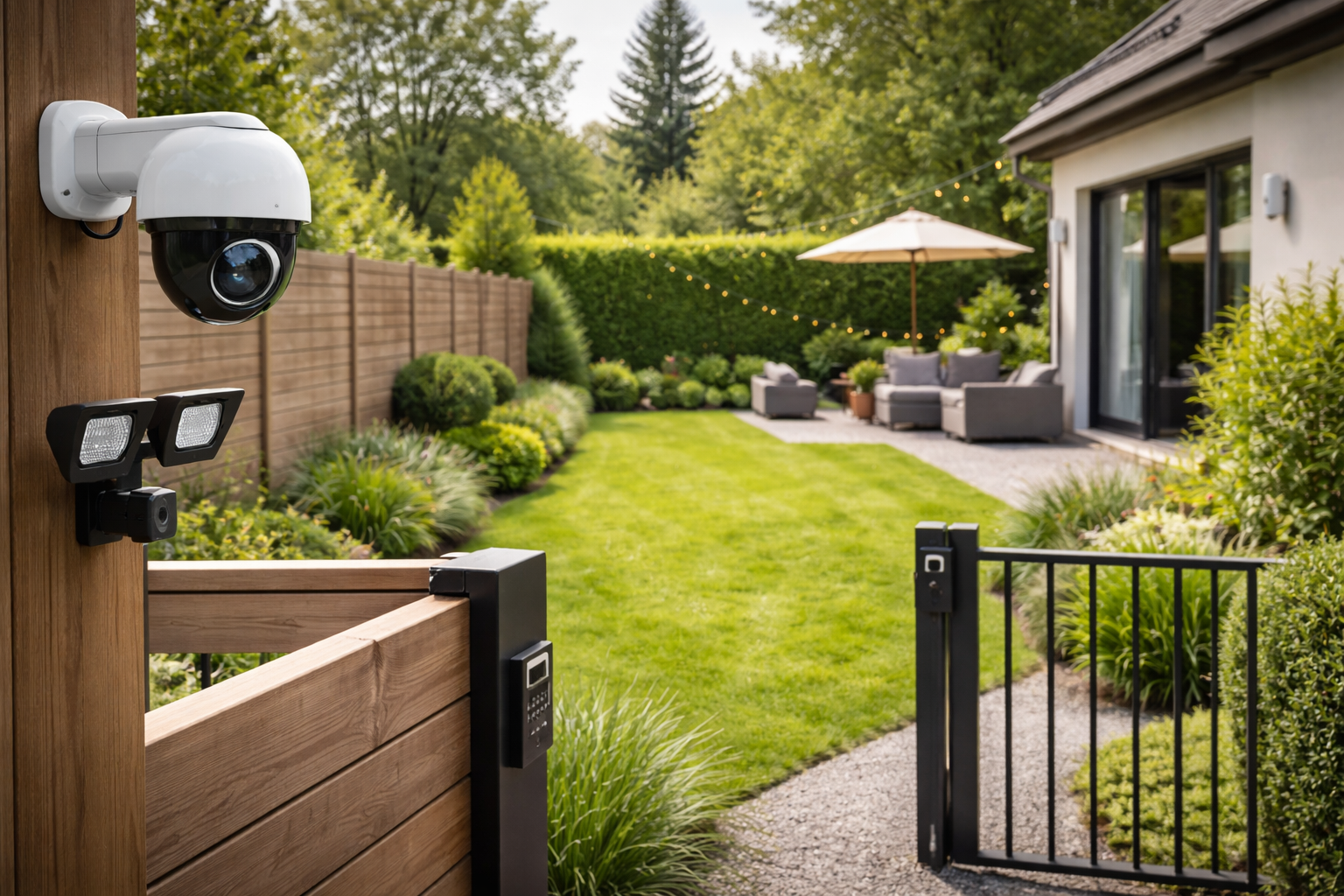
Design and secure your yard to deter burglars before they ever get near the house. This guide sums up the criteria that matter, the mistakes to avoid and the concrete choices that help you decide faster.
When people think about home security, they almost always focus on the front door, the windows, or the indoor alarm. Yet your home’s first line of defense is your yard. Before they ever touch your door, a burglar has to get past your fence, cross your property, and approach without being spotted. A well-designed exterior discourages the vast majority of them before they ever reach your walls.
In fifteen years in the field, I’ve noticed one thing that comes up over and over: people armor their door and forget that the thief spends fifteen minutes in the yard before getting there. That’s precisely where, outside, most of the deterrence plays out. Here’s my complete guide to turning your yard into a real barrier.
The yard, the burglar’s scouting ground
Before acting, a burglar observes. In a few seconds, they size up whether your home is an easy target: can they get close without being seen? Are there hiding spots? Obstacles? A risk of sudden noise or light? Your yard answers all those questions for them. And the stakes are far from minor: according to the FBI Crime Data Explorer, there are roughly 2.5 million burglaries per year in the U.S.
The goal of a successful exterior is captured in three words: slow down, expose, deter. Slow a burglar’s progress with physical obstacles, expose them by removing hiding spots and lighting dark zones, and deter them with signals (a visible camera, crunchy gravel, a yard sign) that raise their risk. Every element below works at least one of these three levers.
Now let’s review, layer by layer, the concrete levers to get there — starting with the most obvious barrier.
1. The physical fence: your first barrier
A fence doesn’t just mark your property line: it’s the first obstacle, physical and psychological, an intruder has to get past. A good fence turns a discreet passage into a visible, risky climb.
- The ideal height: to be a real deterrent, a fence should ideally exceed 6 feet. Beyond that, and depending on your city’s rules, it becomes hard to climb without equipment — and therefore without exposing oneself.
- The type of fence: prefer rigid steel or wrought-iron panels. Steer clear of flimsy chain-link, which gets cut with pliers in seconds, and be wary of cheap privacy panels that, while hiding your privacy, also hide the burglar once they’re inside.
- Defensive spikes: spiked finials along the top of the fence effectively discourage climbing.
- The right visibility/privacy balance: a deterrent boundary that still leaves your facade visible from the street is, paradoxically, safer than a solid 6-ft wall behind which an intruder works undisturbed. If you want privacy screening, save it for the back, out of sight.
✅ The privacy fence
- Preserves your privacy and hides your belongings from scouting
- Blocks wind and street noise
- A deterrent "block" effect out front
⚠️ Its security limits
- Also hides the intruder once they're inside
- More expensive and subject to HOA/zoning rules
- Prevents neighbors from spotting suspicious activity
2. The gate and side gate: locking the obvious access points
A flawless fence is useless if someone walks in through a gate left open. That’s the mistake I see most: well-built access points… that are never locked.
- Go motorized: a motorized gate is far harder to force than a manual one. The motor’s locking system acts as a permanent lock.
- Secure the side gate: never neglect the small pedestrian gate, often the weak link. Fit it with a quality deadbolt lock and, ideally, an electric strike tied to a video intercom to screen visitors.
- Check the hinges: make sure they can’t be lifted off from outside (non-removable or welded hinge pins).
- The free habit: get in the habit of always closing the gate and side gate, even for a five-minute absence. No equipment replaces that reflex.
3. Defensive landscaping: security by nature
Your plants can become real allies. It’s called defensive landscaping: using vegetation to discourage intrusion, without turning your yard into a bunker.
Thorny plants: a living barrier
Planting dense, thorny shrubs under accessible windows and along vulnerable walls is brutally effective: no one wants to push through thorns, much less leave traces behind (clothing, DNA). My go-to choices:
- Holly (Ilex) — prickly, evergreen foliage, dense year-round.
- Hawthorn — fast-growing, sharp thorns, ideal as a hedge.
- Climbing rose and wild rose — perfect under a window.
- Barberry (Berberis) — compact and very deterrent.
- Pyracantha (firethorn) — long thorns and decorative berries.
Place them under ground-floor windows, along climbable low walls, and near downspouts that could serve as a foothold.
Visibility above all
A yard turned into a jungle offers a wealth of hiding spots. Thieves love opacity.
- Trim your hedges: don’t let them mask your facade. Your neighbors and passersby should be able to spot a figure lurking around.
- Clear the area around openings: avoid large bushes hugging doors and windows, which provide a perfect screen for picking a lock out of sight.
- Cultivate the look of being lived in: a maintained lawn and a lively yard signal regular presence, where a neglected exterior screams “no one’s around.”
4. Outdoor lighting: chasing away the shadows
Break-ins very often happen at dusk or in total darkness. Light is the burglar’s number-one enemy — they crave discretion above all.
- Motion sensors: install them around key access points — front door, yard access, garage door, side paths, and the back of the house. The sudden trigger startles them and makes it feel like they’ve been noticed.
- Ambient or timed lighting: a path lightly lit all night maintains constant visibility, reassures the household, and discourages prowlers.
- Solar for spots with no outlet: solar motion-sensor floodlights have come a long way and perfectly cover a far corner of the yard away from the electrical panel.
- Cover the blind spots: it’s exactly the dark corners at the back and sides that interest the intruder, not the facade already lit by the street.
✅ Motion-sensor lighting
- Surprise effect: the sudden light makes them think they've been spotted
- Very economical (only lights up on movement)
- Easy install, wire-free solar models
⚠️ Points to watch
- Nuisance triggers (cats, branches, cars)
- Limited detection zone and range
- Solar loses effectiveness in winter or in shade
To go deeper on choice and placement, see our dedicated guide to motion-sensor security lighting.
5. Gravel and noisy ground: the natural alarm
An often-forgotten but brutally effective trick: ground that makes noise. Replacing a concrete path with gravel makes any silent approach nearly impossible. The crunch underfoot is hard to disguise at night and naturally alerts both occupants and neighbors.
Lay gravel under easily accessible windows, along side passages, and on paths leading to the back of the house. It’s a modest investment for a strong psychological effect: the burglar knows they can’t move in silence.
Is your yard an invitation to burglary?
Let’s pause. You now know the physical and natural barriers — fence, gate, plants, lighting, gravel. Before moving to electronic detection, take an honest look at your exterior: it’s exactly the walk-through I do when I arrive at a client’s home.
🌳 Is your yard an invitation to burglary?
6 questions, 1 minute. The result tells you where to start.
1. Your fence / boundary is…
2. Your gate and side gate are…
3. At night, your outdoor access points are…
4. Under your easily accessible windows, there is…
5. Your tools, ladder, and patio furniture are…
6. Your shed is locked with…
6. Electronic detection in the yard: seeing the intruder coming
Physical obstacles slow them down; electronics alert. Combining the two takes you from a “passive” yard to a yard that reacts before the intruder even reaches the house.
- A visible outdoor camera: double effect — deterrence (if it’s seen) and identification. Aim it at the access points and the most likely point of entry, not just the door. To choose well, see our guide to choosing an outdoor security camera.
- Perimeter infrared beam: two posts that create an invisible beam along the fence or a path. Any break triggers an alert — ideal for detecting an intrusion the moment the boundary is crossed.
- An outdoor motion sensor tied to the alarm: some home alarm systems accept outdoor sensors that warn before a break-in, not during.
- A connected doorbell/camera at the gate: you see and speak to anyone who shows up, even remotely — a simple “yes?” is often enough to make a prowler give up.
7. Securing the shed
It’s almost always overlooked, and yet: the shed is a target in its own right. Mowers, bikes, power tools, furniture… it often holds several thousand dollars of gear — and, worst of all, it hands the burglar the very tools (shovel, pickaxe, ladder, screwdriver) to then go after the house.
- A real padlock: ditch the bargain-bin padlock that gives way to bolt cutters. Choose a high-security, hardened-steel model with a shrouded shackle.
- Reinforce the door: a standard shed door is forced easily. Add a concealed-screw hasp or a security bar.
- Anchor and mark your gear: anchor mowers and bikes to a fixed point with a lock, and mark your tools (engraving, UV marking) to discourage resale.
- Don’t let it signal an absence: a wide-open shed or a banging door betrays inattention — exactly the signal an opportunist looks for.
8. Tools and ladders: don’t supply the equipment
How many times have I found a ladder leaning against the house, a drill on the patio workbench, or a heavy piece of patio furniture right under a balcony? Never hand a burglar their tools.
- Always store your ladders in a locked garage or shed — it’s the #1 object that makes the upper floor accessible.
- Don’t leave heavy furniture (table, bench, planter) that could serve as a step under a window or balcony.
- Bring in anything that can serve as a lever: pickaxes, shovels, bars, screwdrivers, sledgehammers.
- Lock up the power tools: a forgotten angle grinder or cut-off saw outside, and your toughest bike lock is worthless.
9. Protecting furniture, bikes, and outdoor valuables
Everything valuable in a yard doesn’t need the house to be entered to disappear. Bikes, e-bikes, high-end grills, designer furniture, statues, ornamental pots: it’s “grab-and-go” theft, fast and quiet.
- Locks for bikes and e-bikes: a hardened-steel U-lock, secured to an anchored ground point, not just a flimsy fence.
- Anchoring valuable furniture: discreet mounting bolts for designer furniture and the grill, so they can no longer simply be loaded into a trunk.
- Discretion: don’t leave a $4,000 e-bike visible from the street all day. What can’t be seen isn’t coveted.
- Marking and inventory: photograph your valuables and note serial numbers. After a theft, that’s what allows possible recovery and makes an insurance claim easier.
10. Neighbors and good habits: free security
No equipment matches an attentive neighbor. Nearly all of the foiled break-ins I’ve documented were stopped because someone felt that “something was off.”
- Build connections: swap numbers, tell each other about your absences, ask for discreet watching while on vacation. Look into a neighborhood watch group or apps like Nextdoor.
- Don’t advertise your absence: no vacation posts on social media, no mail overflowing the mailbox, no blinds hopelessly shut in the middle of the afternoon.
- Simulate presence: programmed lighting, a moved car, a maintained yard — anything that suggests a lived-in home.
- Use a vacation house-check program: report a prolonged absence to your local police department, many of which do drive-by checks for residents who request it.
For a full overview of all these habits, your starting point remains the pillar guide on how to secure your home against burglary.
The common mistakes that sabotage yard security
Across assessments, the same faults come up. Avoiding them costs nothing and changes everything.
- The solid 6-ft wall: it protects your privacy… and gives the burglar a perfect screen once inside. Prefer a boundary that leaves the facade visible.
- Lighting only on the facade: the street already lights the front. It’s the blind spots at the back that need treating first.
- The high-tech gate that’s never closed: a motorized gate left open all day is useless. Locking has to become automatic.
- The neglected shed: a thin door and a bargain-bin padlock turn your shed into a self-service tool store for the intruder.
- The hedge that masks everything: vegetation that’s too dense near openings creates ideal hiding spots for picking a lock out of sight.
- Betting everything on one device: a camera alone replaces neither the fence, nor the lighting, nor good habits. It’s the layering that deters.
Recap: cost and effectiveness of the solutions
| Solution | Ballpark cost | Effort | Effectiveness |
|---|---|---|---|
| Close/lock the access points | $0 | A habit | ★★★★★ |
| Put away tools & ladders | $0 | A habit | ★★★★★ |
| Trim hedges / clear the view | $0 | Low | ★★★★☆ |
| Gravel under windows 🛒 | $20-80 | Low | ★★★★☆ |
| Defensive thorny plants 🛒 | $30-150 | Medium | ★★★★☆ |
| Motion-sensor lighting 🛒 | $30-150 | Low | ★★★★★ |
| High-security padlock (shed) 🛒 | $20-60 | Low | ★★★★☆ |
| Camera / infrared beam 🛒 | $60-300 | Medium | ★★★★☆ |
| Rigid fence ≥ 6 ft 🛒 | $50-150/linear ft | High | ★★★★☆ |
| Motorized gate 🛒 | $800-3,000 | High | ★★★☆☆ |
The lesson of this table: the free habits and the under-$150 solutions concentrate most of the effectiveness. No point starting with the motorized gate if the ladder is still leaning against the wall.
Action plan: where to start?
🎯 The 5 priorities for a deterrent yard
- Always lock the gate, side gate, and shed (free)
- Put away ladders, tools, and furniture that could be used to climb or force (free)
- Light the access points with motion sensors, especially at the back
- Spread gravel under windows and along passages
- Clear the view of the facade and plant thorny shrubs under openings
Starting budget: from $0 (habits + trimming) to $200-300 for lighting and gravel
Conclusion
Securing your exterior means adopting an “onion” approach: you stack layers of protection. The more physical obstacles (fence, padlock), psychological ones (lighting, the crunch of gravel, a visible camera), or risks (thorny plants, an attentive neighbor) there are, the more you push the intruder to give up for an easier target.
Remember the principle I repeat to every household: the burglar goes for the easiest option. A yard designed to slow down, expose, and deter makes your home anything but an easy target. Start today with the free habits — closing the access points, putting away the ladder, clearing the view of the facade — then gradually add lighting, gravel, and detection as your budget allows. A secure exterior isn’t built in a weekend, but each added layer brings you closer to a truly deterrent yard. Once the yard is handled, move on to the front door and choosing your outdoor camera.
Get a free quote within 24 hours from a licensed, UL-certified installer near you — no obligation, zero spam.
Frequently Asked Questions
What fence height deters burglars?
A rigid fence at least 6 ft tall is a real deterrent: hard to climb without equipment and without exposing oneself. Check your city’s zoning code and HOA rules, though, which set allowed heights and materials. Prefer steel or wrought iron over flimsy chain-link, which gets cut in seconds.
What plants prevent intrusions?
Dense, thorny shrubs are the most effective under windows and along walls: holly, hawthorn, climbing rose, barberry (Berberis), and pyracantha. Planted at vulnerable points, they create a natural barrier no one wants to push through.
Is gravel really effective against burglaries?
Yes, it’s a simple and brutally effective trick. The crunch underfoot makes any silent approach impossible and naturally alerts occupants and neighbors. Place it under accessible windows and on passages leading to the back of the house.
How do I secure a shed?
Replace the bargain-bin padlock with a high-security, hardened-steel padlock with a shrouded shackle, reinforce the door (concealed-screw hasp or bar), and anchor the mower and bikes to a fixed point. The stakes are twofold: protect the stored gear and deny the burglar the tools they’d use to attack the house.
Do I need an alarm or camera for the yard?
It’s an excellent complement to the physical obstacles. A visible outdoor camera deters and identifies; an infrared beam or an outdoor sensor tied to the alarm alerts you the moment the boundary is crossed — before a break-in. Make sure you only film your own property.
What outdoor lighting should I choose for security?
LED motion-sensor floodlights at key access points (entrance, garage, back, side paths), complemented by timed ambient lighting for constant visibility. For areas far from an outlet, solar motion-sensor models are perfect. Prioritize the blind spots at the back, where the intruder thinks they’re invisible.
Sources and references
- FBI Crime Data Explorer — Burglary statistics — official U.S. burglary data.
- UL Solutions — performance standards and listings for security equipment.
- Burglary prevention resources (DOJ/COPS) — securing your home while you’re away.
