

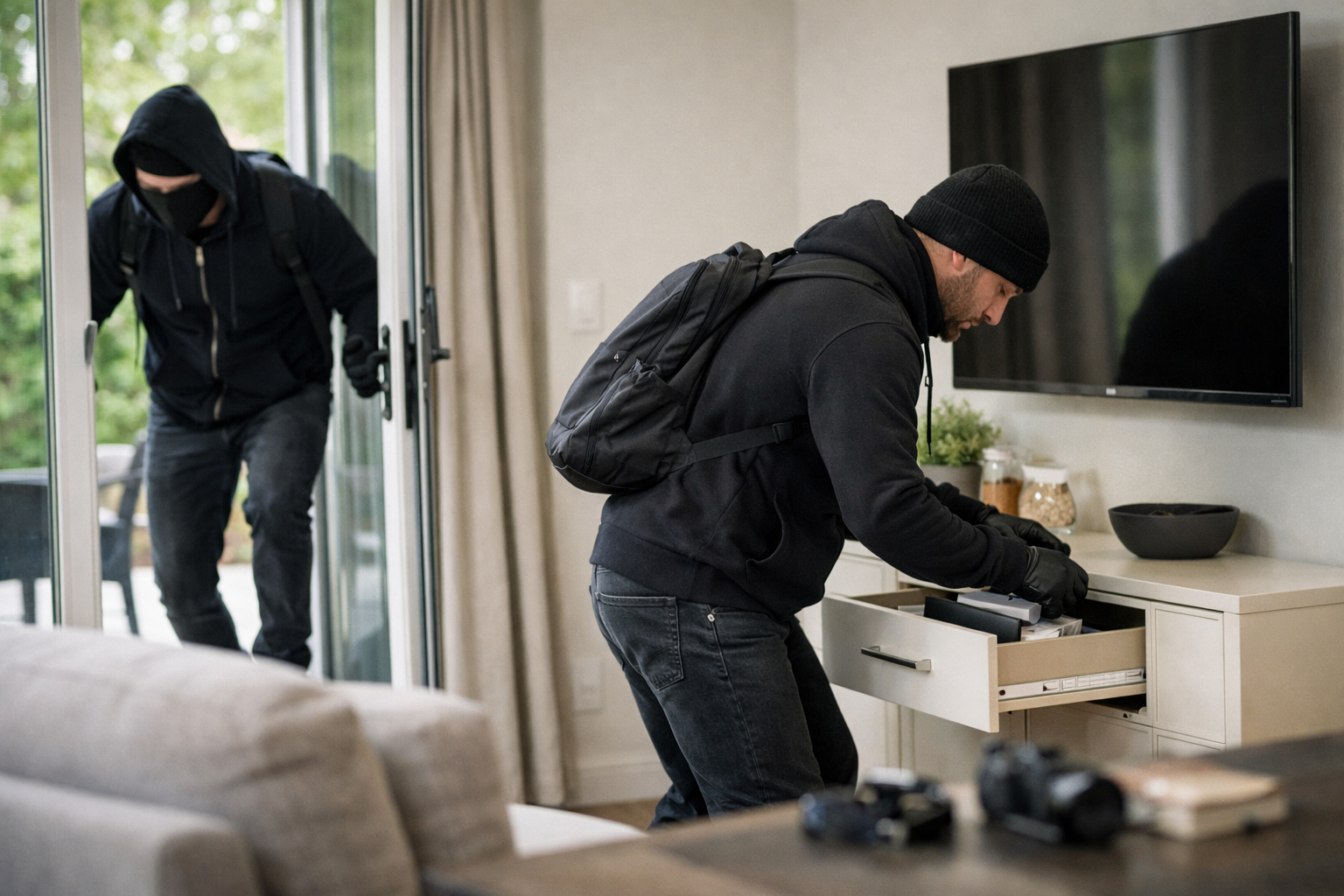
Real lessons from burglary victims: common mistakes, overlooked signals, and practical takeaways to better protect your home. This guide sums up the criteria that matter, the mistakes to avoid and the concrete choices that help you decide faster.
Every year, about 2.5 million burglaries are recorded in the US. Behind these numbers are families who go through real trauma. We collected the stories of several victims to draw out concrete lessons that could spare you the same ordeal.
Story #1: “We thought it only happened to other people”
Sophie and Marc, 42 — Single-family home in suburban Chicago
“We’d gone out to run errands one Saturday afternoon, barely 2 hours. When we got back, the front door was broken open. We couldn’t believe it. We always told ourselves: it only happens to other people.”
What happened
The burglars took advantage of a short absence, in broad daylight. The front door had a basic deadbolt, with no reinforced strike plate. A single pry bar was enough to force the entry in under 30 seconds.
The mistakes identified
- ❌ An old lock, never replaced since they moved in
- ❌ No alarm system
- ❌ No visible outdoor camera (no deterrent effect)
- ❌ Open blinds signaling a short absence
The lesson
A burglary doesn’t only happen during vacations. More than 60% of break-ins occur between 2 p.m. and 5 p.m., when occupants are at work or running errands. A reinforced door and an armed alarm, even for a 30-minute absence, make all the difference.
Story #2: “The burglar came in through the ground-floor window”
Laurent, 55 — House in a semi-rural area
“I thought my reinforced door was enough. But they didn’t even come through the door. They broke a window at the back of the house, on the yard side. All of it in the middle of the night, without us hearing a thing from upstairs.”
What happened
The burglar went around the house through the yard, unfenced on the neighbor’s side. They forced a tilt-and-turn window left cracked open on the ground floor. No door/window contact, no alarm. They operated while the family slept upstairs.
The mistakes identified
- ❌ Ground-floor windows with no reinforcement or sensor
- ❌ A yard accessible with no obstacle (no fence or defensive hedge)
- ❌ A window left cracked open at night
- ❌ No outdoor motion sensor
The lesson
The front door isn’t the only point of access. Nearly 30% of burglaries come through windows. It’s essential to secure every ground-floor access point: windows, patio doors, garage doors, and never leave an opening at night.
Story #3: “Our valuables were too easy to find”
Nathalie, 38 — Ground-floor apartment in Houston
“They turned everything over in a few minutes. The jewelry was in a box on the bedroom dresser. The cash in a desk drawer. They knew exactly where to look, like it was their job — and it is their job.”
What happened
The burglar came in through the living-room patio door, whose lock was faulty. They went straight for the bedroom and the home office — the two rooms where 90% of people keep their valuables.
The mistakes identified
- ❌ Jewelry and cash stored in the most obvious places
- ❌ No safe, not even a basic one
- ❌ A patio door with a defective lock, never repaired
- ❌ No photos or inventory of valuables (complicates the insurance claim)
The lesson
Burglars know your storage habits. The bedroom, the office, and the bathroom are searched first. A safe bolted to the wall (starting at $80) makes their job considerably harder. And remember to photograph your valuables to ease the insurance claim.
- A safe bolted to the wall or floor — in an unexpected room (laundry room, pantry)
- Diversion safes — fake books, fake electrical outlets (for small items)
- A bank safe-deposit box — for very high-value items rarely worn
- Avoid — the nightstand, the sock drawer, the freezer (too well known)
Story #4: “The alarm changed everything”
David and Emily, 45 — House in Phoenix, burglarized twice
“The first time, we had nothing. They came in, took what they wanted, and left. The second time, we’d installed an alarm with cameras. The alarm went off, they fled in 15 seconds. The camera let us identify them.”
What happened
After a first traumatic burglary, David and Emily invested in a complete alarm system with a siren, sensors, and outdoor cameras. During the second attempt, 8 months later, the indoor siren (110 dB) went off instantly. The burglars fled without taking anything.
What they installed
| Equipment | Role | Approximate budget |
|---|---|---|
| Wireless alarm with siren | Detection and instant alert | $200–$400 |
| 2 outdoor cameras | Deterrence + identification | $100–$200 |
| 4 door/window contacts | Windows and doors | $60–$120 |
| 1 motion sensor | Main hallway | $30–$50 |
| ”Alarm” stickers | Visual deterrence | $5–$10 |
| Total | $400–$780 |
The lesson
An alarm system remains the best security investment. Even a basic $200 system cuts the risk of a completed burglary by a factor of 3. The alarm + camera combination is remarkably effective: deterrence, alert, identification.
The 8 Most Common Mistakes Victims Make
By analyzing these stories and law enforcement statistics, here are the mistakes that come up most often:
| # | Mistake | Frequency |
|---|---|---|
| 1 | Not locking the door (just pulling it shut) | Very common |
| 2 | Not arming the alarm for short absences | Very common |
| 3 | Leaving windows cracked open (especially at night) | Common |
| 4 | Storing valuables in obvious places | Common |
| 5 | Neglecting the security of secondary access points (garage, basement, windows) | Common |
| 6 | Announcing absences on social media | Frequent |
| 7 | Having no photo/inventory of valuables | Frequent |
| 8 | Putting off installing a security system | Very frequent |
The Lessons to Remember
Think like a burglar
Walk around your home and look for the weak spots: an easily accessible window, a fragile door, no visibility from the street. Anything that looks easy to exploit to you is just as easy for an intruder.
Deterrence is your best weapon
A burglar always picks the easiest target. On a street of 10 houses, they’ll go for the one with no alarm, no camera, and no lighting. Make your home less attractive than your neighbor’s:
- Visible alarm (stickers, exposed siren)
- Outdoor camera in plain view
- Motion-sensor lighting at the access points
- Closed blinds when you’re away
Secure EVERY access point
There’s no point installing a reinforced door if the window next to it opens with a simple push. Think holistically:
- Front door: multipoint lock + reinforced strike plate
- Ground-floor windows: keyed handles + door/window contacts
- Garage door: reinforced lock + sensor
- Patio doors: security film + a blocking bar
Prepare for the worst
Even with the best protection, zero risk doesn’t exist. Plan ahead:
- Photograph all your valuables with the receipts
- Note the serial numbers of your electronics
- Keep a digital copy in the cloud (not just on a PC in the house)
- Review your homeowners or renters insurance clauses every year
What to Do if You’re the Victim of a Burglary
If the worst happens, here are the steps to follow immediately:
- Don't touch anything — Preserve the evidence for the police
- Call 911 (Police) — File a police report as soon as possible
- Contact your insurer — Report the claim within the deadline in your policy
- Make a detailed inventory — List all stolen or damaged items with their value
- Secure your home — Have the locks changed immediately if keys were stolen
- Consider psychological support — Post-burglary trauma is real and underestimated
Get a free quote within 24 hours from a licensed, UL-certified installer near you — no obligation, zero spam.
Don’t Leave It to Chance
All the stories converge on the same conclusion: burglars take the path of least resistance. A minimum of precautions is enough to steer them toward another target.
If you haven’t secured your home yet, start with these 3 immediate actions:
- Install an alarm, even a basic one — it’s the most cost-effective investment
- Reinforce your front door — multipoint lock + reinforced strike plate
- Add motion-sensor lighting at your outdoor access points
