

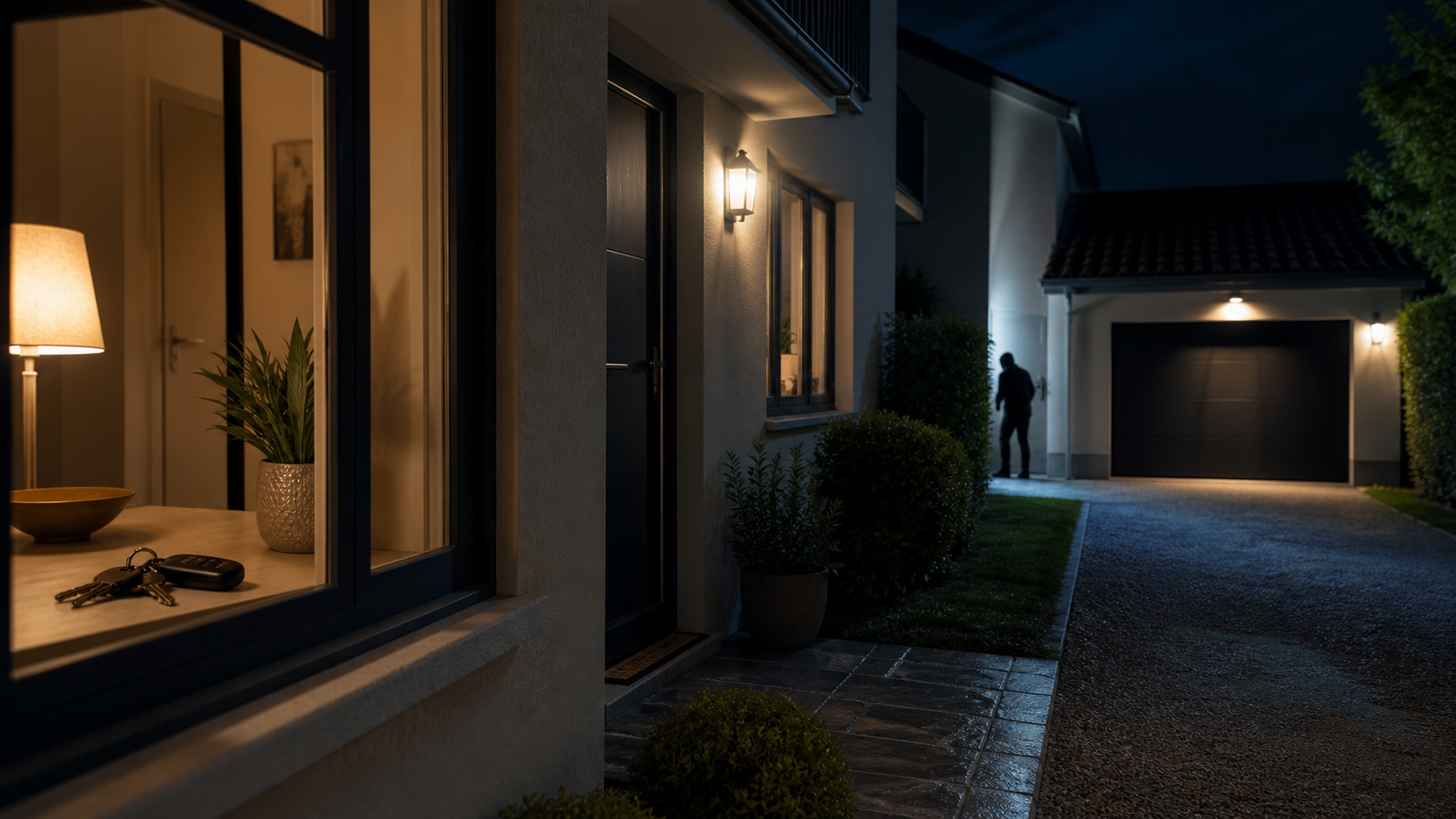
A complete guide to home invasion: nighttime break-ins, car-key theft, night-mode alarms, family reflexes, and what to do if someone enters your home. This guide sums up the criteria that matter, the mistakes to avoid and the concrete choices that help you decide faster.
A home invasion is one of the most distressing forms of break-in, because it isn’t limited to a theft committed while you’re away. It involves entering a home while the occupants are present, often to quickly steal car keys, jewelry, cash, credit cards, phones, or any easy-to-grab item. The fear doesn’t come only from the material loss: it comes above all from the fact that the most intimate boundary, that of an occupied home, has been crossed.
I often tell the families I work with: keep a cool head. Good prevention isn’t about turning your home into a fortress, nor imagining the worst at every noise. It’s about reducing opportunities, organizing family reflexes, and knowing what to do if a break-in occurs. In this guide, I’ll explain how to recognize the typical scenarios, how to limit the risk, and, above all, how to respond without putting yourself in danger.
If you’re looking for how to prevent a home invasion, what to do if someone enters your home at night, how to protect your car keys, or how to set up an alarm while you sleep, the answer rarely comes down to a single piece of equipment. It comes down to a string of small, coherent choices.
Before you read on, here’s a quick diagnostic. It doesn’t replace a full audit, but it often puts a finger on the two or three habits that change everything.
🚪 Is your household prepared for a home invasion?
6 questions, 1 minute. Answer honestly: the score is for prioritizing, not judging.
1. In the evening, your front and secondary doors are...
2. Your car keys and gate remotes are...
3. How is the garage-to-house access protected?
4. At night, your alarm or sensors...
5. Sensitive outdoor approaches are...
6. If a suspicious noise happens at night, your family knows to...
What Is a Home Invasion?
Law enforcement defines a home invasion as a burglary technique that involves entering a home while its occupants are present. In practice, the term often describes a nighttime or evening intrusion, with a very concrete objective: to quickly grab valuables, and sometimes the keys to a vehicle parked in front of the house or in the garage.
The difference from a standard burglary is major. In an absence burglary, the intruder generally tries to avoid running into anyone. In a home invasion, they accept the risk of presence, or even exploit it: occupants asleep, a late return, a door open for a few seconds, a garage in the middle of closing, a delivery or a false pretext. It’s this presence that makes the situation more sensitive.
There are several scenarios:
- The discreet nighttime intrusion: the occupants are asleep, the intruder enters through a poorly locked door, an accessible window, or a garage.
- Targeted car-key theft: the main objective is the vehicle, especially if the keys are visible by the entry.
- The opportunistic entry: a door left unlocked while the family is in the yard, upstairs, or in front of the TV.
- The false pretext: door-to-door soliciting, a fake emergency, a delivery person, a fake technician, or a request for help to get the door opened.
- The unexpected confrontation: the intruder thought the home was empty or the occupants asleep, then runs into someone.
What these scenarios have in common is simple: a home invasion takes advantage of a moment of letting your guard down. Prevention, then, is about removing easy openings, making the approach visible, and keeping the targeted valuables out of immediate reach.
The Signals That Attract Intruders
A home invasion doesn’t always follow long, methodical scouting. Many cases rely on visible clues and opportunities. Certain signals raise the risk because they suggest something worth stealing or an easy way in.
The first signal is the visible car. A high-end, recent, or very recognizable vehicle parked in front of the home can draw attention. That’s no reason to live in hiding, but it should push you to protect the keys and access to the garage. Keys dropped in a tray by the door are one of the simplest mistakes to fix.
The second signal is the predictable routine: a gate always open at the same time, a garage door left up for several minutes, kids who come home alone and leave the door cracked, a patio door not locked in the evening. Intruders often exploit repeated habits.
The third signal is poor outdoor visibility: a dark yard, a solid hedge, a side of the house invisible from the street, no lighting at the rear. The more discreet the approach, the more attractive it becomes. It’s exactly the same principle as for securing the yard.
Finally, there are the digital signals: posting a new car, photos of valuables, geotagged stories, an address visible on a listing or a package, overly precise information about your schedule. These don’t cause a home invasion on their own, but they can feed scouting.
How to Prevent a Home Invasion: The Priority Protections
Protection against home invasion has to start with the access points, but it doesn’t end at the locks. I always think in layers: prevent easy entry, slow down the intrusion, alert quickly, and limit the appeal of theft.
1. Lock Up Even When You’re Home
This is the simplest and most underestimated reflex. Many home invasions begin with an unlocked door, especially in the evening. Being present isn’t enough to protect the home. Someone can come in while you’re in another room, in the shower, in the yard, or upstairs.
The rule is clear: lock the door as soon as you’re inside, especially in the evening and at night. If the door needs to stay easy to open in an emergency, choose a suitable lock with simple interior egress, but don’t leave it freely accessible from the outside.
To protect an occupied home, this reflex counts as much as a high-end lock: an unlocked door often cancels out the rest of the setup.
2. Keep Car Keys Away From the Entry
Car keys, house keys, fobs, gate remotes, and vehicle paperwork shouldn’t be visible from a window or accessible from the door. Avoid the tray by the entry, the key hook near the lock, or the hallway console.
Instead, set up a drop zone deeper inside the home, out of sight. For keyless-entry vehicles, use an RFID-blocking pouch or a suitable metal box to limit relay attacks. This becomes important as soon as the car sleeps outside or near the front of the house.
Car-key theft from the home is one of the fastest scenarios: the intruder doesn’t always set out to rummage, sometimes they’re simply looking for a visible set of keys, a gate remote, or a garage opener.
3. Lock the Garage Like a Real Entry
The garage is often treated as a secondary room, when it sometimes gives direct access to the home. The door between the garage and the house should be as serious as an exterior door: a proper lock, a solid-core door, locked every time. Never leave the vehicle keys in the garage, especially if it’s accessible through a weak side door.
If your gate or garage door is motorized, check the auto-close, the lighting, and the condition of the remotes. A remote left in a car parked outside can become an invitation.
4. Light the Approaches
Motion-sensor lighting doesn’t prevent everything, but it changes the risk calculation. A sudden burst of light surprises, exposes, and creates doubt. Prioritize the rear access points, the sides of the house, the garage door, the gate, and the areas where someone could wait out of sight.
To go further, see the dedicated guide on motion-sensor security lighting.
5. Install a Useful Night-Mode Alarm, Not Just a Siren
An alarm can be very effective if it’s designed for an occupied home. Partial, perimeter, or night modes let you protect the openings while you sleep, without triggering at every interior movement. Door/window contacts on the front door, garage door, and patio door are especially relevant.
If your question is “which alarm against a nighttime break-in?”, I advise looking first at zone management: doors and patio doors protected, interior movement free, reliable notification, an SOS button known to the adults.
The goal isn’t to live under a permanent alarm. The goal is to receive an alert if an access point opens at night or if a sensitive outdoor zone is crossed. Cameras can complement this setup, as long as you respect privacy rules: a private individual should record only their own property, not the public street or a neighbor’s land.
6. Plan a Realistic Safe Room
People sometimes picture the safe room as a bunker. In an ordinary house, it’s more like a room where you can shut yourself in for a few minutes: a bedroom with a door that locks, a phone available, a window for raising the alarm, the kids gathered together. The idea isn’t to withstand a siege, but to buy time and call for help.
This room should be known to every member of the household. Children don’t need anxiety-inducing details: they just need to know that, on a clear cue, you go to a specific room and stay together.
What to Do During a Home Invasion or Nighttime Break-In
The response depends on the situation, but a few principles stay constant.
Keep Your Hands Visible and Avoid Confrontation
If you come face to face with one or more intruders, don’t try to play the hero. Speak little, slowly, without provoking. Don’t make sudden moves toward a pocket, a drawer, or a phone if the intruder is watching you. Your goal is to lower the tension.
If the attackers demand keys, a code, or an object, the prudent recommendation is not to resist physically. Possessions are insurable. The risk of injury isn’t worth an improvised standoff.
Don’t Chase the Intruders
After they flee, the adrenaline sometimes pushes you to run after them, jump in the car, or try to recover an item. That’s a mistake. You don’t know if they’re armed, how many there are, or whether they have accomplices outside. Stay with the occupants, get to safety, and call for help.
Call 911 as Soon as You Can
Call the police as soon as you’re safe. Give simple information: address, number of intruders if you saw them, direction of flight, any vehicle, a general description, any injuries. Don’t hang up until you’re told to.
If you can’t speak, prioritize discretion and safety. Some alarm systems offer a silent SOS button. It can be useful, but it has to be tested and understood before the emergency.
Preserve the Evidence
Once the danger has passed, don’t touch handles, drawers, forced windows, moved objects, or surfaces that were handled. Close access points if necessary for your safety, but avoid cleaning or tidying. The evidence can help the investigation.
After the Intrusion: The 6 Priority Actions
- Get everyone to safety: check for injuries, shock, the children, the elderly.
- Call law enforcement: 911.
- Don’t disturb the scene: preserve the evidence and wait for instructions.
- Block payment methods and phones: credit cards, mobiles, digital keys, cloud access if needed.
- File an insurance claim: contact your insurer quickly with the police report number and any available documentation.
- Repair the weak access points: lock, door, glazing, garage, lighting, codes, and remotes.
Filing a police report is what allows the perpetrator to be pursued. In a home invasion, depending on the circumstances, there may also be assault, threats, unlawful restraint, or aggravated theft. Don’t minimize the facts when you describe them.
Anonymized Testimonials: What Victims Take Away
The accounts below are composite, anonymized testimonials, built from recurring situations encountered in victims’ experiences. The names are fictional, but I write them in the first person because that’s often how victims really tell the event: in small scenes, with a detail that sticks.
Claire: “The keys were by the door”
Claire lived in a quiet house with two children. One evening, while the family was watching a movie, someone came in through the unlocked side door. The intruders barely searched anything: they took the car keys sitting in a bowl by the entry, a bag, and two phones. The car was gone in under two minutes.
“I thought being home was enough. In reality, I was in the living room, the side door was behind us, and I heard nothing. What stuck with me wasn’t just the stolen car: it was the idea that someone had walked through our house while my kids were there.”
What Claire changed afterward: the side door locked every time, the keys moved to a closed cabinet, a door/window contact in night mode, and automatic lighting on the yard side. Her regret isn’t the absence of some sophisticated gear, but the fact that everything was accessible in one place.
Karim: “I went downstairs too fast”
Karim heard a noise in the garage around 3 a.m. He went down alone, convinced he’d surprise “some kid.” He ran into two people, shouted, then got shoved. The intruders left with very little, but the fear lingered for a long time.
“In the moment, I wanted to check, as if I were going to take back control. I went downstairs too fast, without a phone, without telling my wife. After the fact, I understood that I’d mostly added danger to an already bad situation.”
His takeaway: don’t go down alone, don’t give chase, call first. He installed a contact sensor on the garage door, an indoor camera aimed at the garage-to-house access, and a family routine: at any suspicious noise, everyone stays upstairs, phone in hand, bedroom door closed.
Sophie: “The hardest part is the aftermath”
Sophie wasn’t hurt. The intruders fled the moment the alarm went off. And yet she didn’t sleep properly for several weeks. She jumped at the slightest noise and avoided certain rooms. This point is often underestimated: an intrusion experienced with the occupants present can create real psychological shock.
“Everyone kept telling me: thank goodness, they left. Yes, of course. But I kept looking at the door, the windows, the hallway. I needed the evidence repaired quickly, not just for safety, but to stop reliving the scene every night.”
What helped her: changing the lock quickly, having the visible damage repaired, talking with the neighbors, going over the plan with her kids without dramatizing, and asking her doctor for advice. Security isn’t only technical; it also serves to restore a sense of control.
Recap Table: Anti-Home-Invasion Priorities
| Measure | Approx. cost | Priority | Goal |
|---|---|---|---|
| Lock the doors even when home | $0 | Very high | Prevent opportunistic entry |
| Keep keys and papers away from the entry | $0 | Very high | Reduce immediate appeal |
| Alarm night mode 🛒 | $0–$300 | High | Alert without disturbing occupants |
| Motion-sensor outdoor lighting 🛒 | $20–$150 | High | Expose the approach |
| Reinforce garage-to-house door 🛒 | $80–$600 | High | Block a secondary access |
| Camera on private access points 🛒 | $50–$300 | Medium | Verify and document |
| RFID-blocking pouch for keys 🛒 | $10–$30 | Medium | Limit relay theft |
| Simple family procedure | $0 | Very high | Avoid panic |
Common Mistakes
- Leaving keys by the entry: convenient for daily life, very convenient for an intruder too.
- Opening to a stranger without screening: use the door chain, the peephole, the video doorbell, or speak through a closed door.
- Going downstairs alone in the middle of the night: you don’t know the number or intent of the intruders.
- Filming the street with a private camera: it can pose legal problems and diverts the camera from its real mission.
- Relying only on the front door: garage, patio door, back door, and side gate are often weaker.
- Explaining nothing to the children: a simple, reassuring instruction beats an anxiety-inducing silence.
A 30-Minute Action Plan
Start with a walk-through of the home tonight. It’s the exercise I do first: I mentally lock myself outside and ask, “If I wanted to get in fast and quietly, where would I go?” Look at the entry, the garage, the patio doors, the keys, the remotes, the lighting, the gate, and the low windows. Note three immediate fixes.
Then apply this plan:
- Move keys and sensitive papers out of the entry.
- Lock all the doors in the evening, including the side and garage doors.
- Test the outdoor lighting and replace the dim bulbs.
- Turn on or set up your alarm’s night mode if you have one.
- Define a simple family plan: gather together, don’t go downstairs, call.
- List the useful numbers: 911, insurance, a trusted neighbor, bank fraud line.
These six moves cost almost nothing and immediately raise your level of preparedness.
Conclusion
A home invasion is frightening because it touches on presence, on night, on family, and on the intimacy of the home. But the answer shouldn’t be panic. It should be methodical: close the access points, keep the targeted valuables out of reach, light the approaches, set up a useful alert, and prepare a family response without confrontation.
Remember one phrase: during the event, you protect people; after the event, you protect the evidence; before the event, you remove the easy openings. That’s the logic that truly reduces the risk.
To round out this page, also read the pillar guide on how to secure your home against burglary, then check the weak points burglars target.
Get a free quote within 24 hours from a licensed, UL-certified installer near you — no obligation, zero spam.
Frequently Asked Questions
What's the difference between a burglary and a home invasion?
A standard burglary is often committed when the home is empty. A home invasion refers to an intrusion while the occupants are present. That presence raises the risk of confrontation and calls for different safety reflexes.
Should you hide your car keys?
Yes, at minimum keep them away from the entry and the windows. Don’t leave them in a visible or accessible tray. For keyless-entry keys, an RFID-blocking pouch can limit certain relay thefts.
How do you prevent car-key theft from the home?
Keep keys away from the entry, out of sight of a window, and far from the door. Avoid the key hook, the visible tray, the vehicle paperwork in the same cabinet, and accessible gate remotes. For a keyless-entry key, add an RFID-blocking pouch or a suitable metal box.
What should I do if I hear someone coming in at night?
Don’t go downstairs alone. Gather the occupants if possible, close a door between you and the intruder, call 911 as soon as you’re safe, and give simple information. Avoid any confrontation.
Does an alarm protect against a home invasion?
It helps if it’s configured for occupancy: night mode, door/window contacts, perimeter zones, and an SOS button. A whole-home alarm that forces you to disarm everything when you’re home will be less useful.
How do you protect your home at night while you sleep?
Lock the doors, keep the keys away, turn on the alarm’s night mode, light the sensitive approaches, and keep a phone within reach. The right logic is to protect the openings while the occupants can move around normally inside.
Am I allowed to film in front of my house?
A private individual can film their own private property, but not the public street or a neighbor’s land. Aim the cameras at your own access points and use privacy masking zones if needed.
How do you reassure children without worrying them?
Give a simple instruction, like a fire drill: at a noise or an alert, you go to such-and-such room, stay together, an adult calls. There’s no need to describe violent scenarios.
Sources and References
