
Your shed holds the tools that open your house. Hasps, padlocks, hinge bolts, ground anchors and alarms — the layered fix, in the order that actually matters. This guide sums up the criteria that matter, the mistakes to avoid and the concrete choices that help you decide faster.
There’s a particular kind of homeowner conversation I’ve had dozens of times. We’re standing in the backyard, and I ask what’s in the shed. The answer comes back easily: “Nothing much. Lawn mower, tools, the kids’ bikes.”
Then we add it up. A mower, a pressure washer, a chainsaw, two e-bikes, a cordless tool set, a ladder. Six thousand dollars, behind a door held shut by a $6 hasp and a padlock you could cut with bolt cutters from the hardware store.
And that’s only the direct loss. The shed is also where a burglar finds the crowbar, the ladder, and the cordless grinder they will then use on your house — usually while standing in a spot the street can’t see. Securing the shed isn’t about the mower. It’s about not stocking the burglar’s toolkit ten feet from your back door.
Why the shed is a priority target
It ticks every box a burglar cares about:
- It’s out of sight. Back of the lot, behind the house, screened by a fence. Whatever happens there isn’t visible from the street.
- It’s built light. Thin plywood or vinyl walls, hollow doors, hinges on the outside. The structure itself is barely a barrier.
- The lock is usually an afterthought. A hasp screwed into softwood with the fasteners exposed.
- The contents got expensive. Sheds today hold e-bikes at $2,000–4,000 each, battery tool platforms, robot mowers, and increasingly, lithium batteries worth stealing on their own.
- There’s no alarm. The house has one; the shed almost never does.
- It arms the next step. This is the part homeowners underestimate — the shed supplies the tools for the break-in that follows. Our guide to a home’s weak points covers where those tools then get used.
Level 1 — The mechanical basics (non-negotiable)
Do these four things and you’ve eliminated the opportunistic theft that makes up the bulk of shed losses.
The hasp is more important than the padlock
A standard shed hasp is a thin steel plate held by short wood screws, with the fasteners visible when the door is closed. That’s two failure modes: unscrew it, or pry it off.
What to fit instead:
- A concealed-fastener hasp — the closed position covers the bolt heads so nothing can be driven or turned.
- Through-bolted, not screwed. Use carriage bolts through the door and frame with washers and nuts on the inside. Bolt heads are round and smooth on the outside — nothing for a wrench or screwdriver to grip.
- Thick steel with a hardened staple, and a body that shrouds the padlock shackle once closed.
Then the padlock
With a proper hasp in place, the padlock matters. What to look for:
- A shrouded or closed-shackle body so bolt cutters can’t get a bite. This single feature does more than any other.
- A boron-alloy or hardened-steel shackle, not plated pot metal.
- A weather-rated body — a seized padlock in February is its own kind of failure.
- An ANSI/BHMA grade where available; that’s the US benchmark for padlock security and durability.
Budget $30–70 for something genuinely resistant. A $10 padlock is a suggestion, not a lock.
Hinges: the side everyone forgets
You can bolt the lock side shut perfectly and lose the door on the other edge. Many shed doors have exterior hinges with exposed screws — remove six screws and the door lifts off, padlock still locked.
Two fixes, both cheap:
- Replace the hinge screws with carriage bolts through the door, washers and nuts inside.
- Fit hinge bolts (dog bolts): fixed pins on the hinge edge of the door that seat into holes in the frame when it closes. Even with the hinges removed, the door can’t swing free. Around $10–20 a pair.
Windows and walls
Shed windows are usually single-pane and low. If yours has one:
- Fit an interior screen or grille, or cover the glass with 8-mil security film.
- Or just block the sightline. A shelf, a board, or opaque film. Nobody breaks into a shed they can’t see anything worth taking in — a huge part of shed theft is opportunistic and visual.
For the walls themselves, be realistic: a determined attacker can cut through a thin shed panel. What stops them is time, noise, and the risk of being seen — which is what the rest of this guide is about.
Level 2 — Anchor what’s worth the most
If the shed contains bikes, a motorcycle, or high-value tools, the second layer is anchoring them to the building itself. A locked shed with an unsecured e-bike inside is one barrier; a locked shed with the bike chained to a ground anchor is two, and the second one requires noisy, time-consuming work in a confined space.
- Ground anchor bolted into the slab — the best option if the shed has a concrete floor. Use expanding masonry anchors and a shrouded chain.
- Wall anchor through a stud — the alternative on a wooden floor. Through-bolt it, don’t lag into thin sheathing.
- A hardened chain and lock, not a cable. Cables are cut in seconds with hand tools.
For an e-bike, this matters more than the shed’s own lock: batteries and complete bikes are the fastest-growing category of outbuilding theft, and they’re light enough to carry away in one trip.
Level 3 — Detection and deterrence
Mechanical layers buy time. These tell you it’s being spent.
| Device | What it does | Typical price | Notes |
|---|---|---|---|
| Standalone shed alarm | Siren on the door opening | $25–60 | Self-contained, battery, no hub needed |
| Motion light | Removes the darkness | $25–80 | The cheapest real deterrent there is |
| Solar battery camera | Alert + evidence | $60–200 | No wiring needed to the shed |
| Tracker tags in tools | Recovery after the fact | $25–100 | Hide one inside a tool case, not on it |
If the shed has no power and no Wi-Fi reaches it — common for a shed at the back of a lot — a solar battery camera solves it without a trench. See our guide to cameras with no Wi-Fi and no power if there’s no signal either.
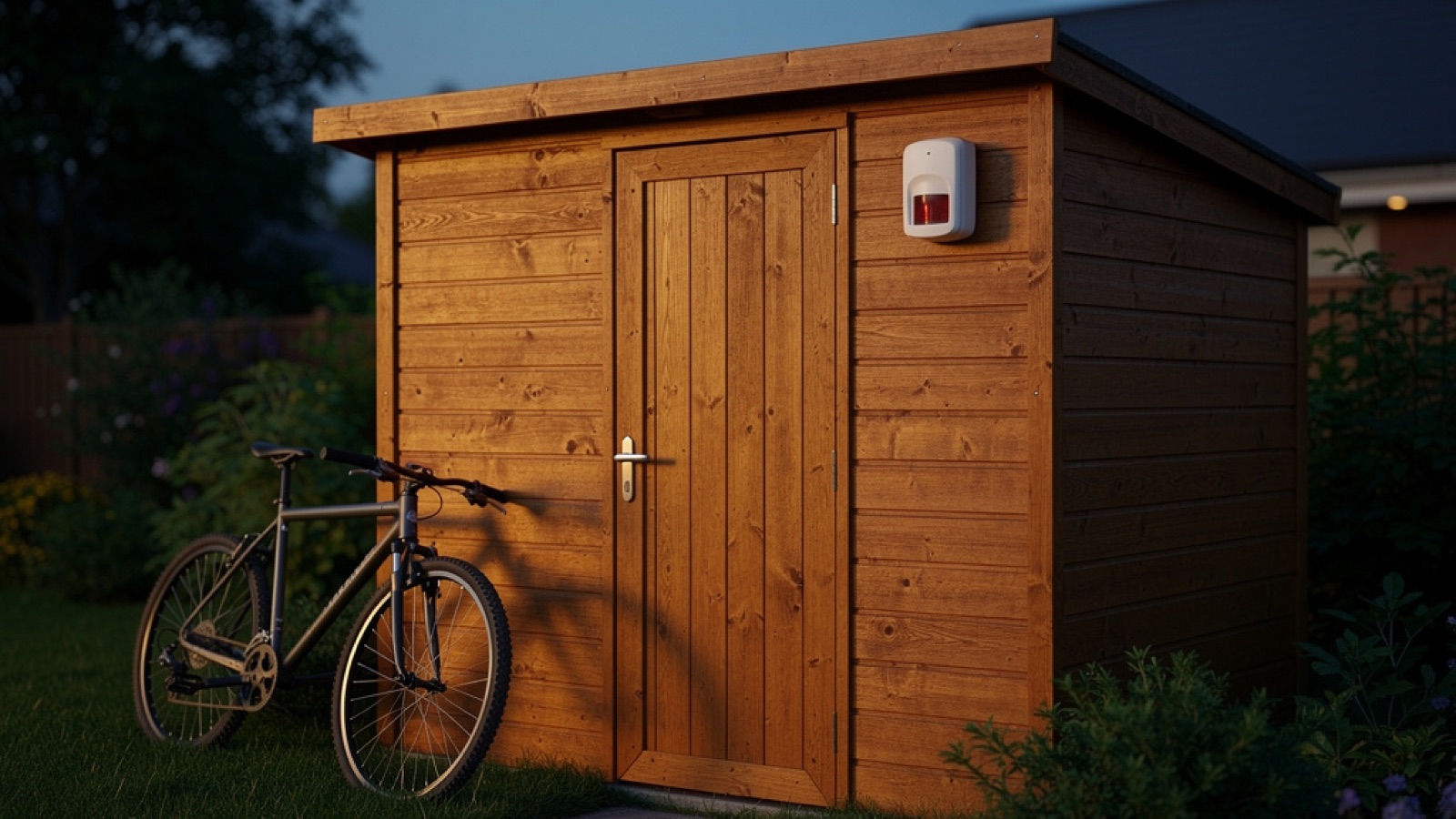
A standalone shed alarm is the highest-value item on that list. A 110 dB siren going off in a quiet backyard at 2 a.m. ends most shed break-ins immediately — the thief’s whole plan depended on nobody knowing.
Quiz: what security level does your shed need?
🏡 How far should you go on the shed?
3 questions, 20 seconds. The result gives you the priority.
1. What's stored in there?
2. Is the shed visible from the house or the street?
3. Is there power or Wi-Fi at the shed?
The free habits that change the outcome
None of these cost anything, and together they’re worth as much as the hardware:
- Never leave the ladder outside — or in an unlocked shed. A ladder is a first-floor problem turned into a second-floor problem. Chain it, or store it inside the house or garage.
- Don’t advertise the contents. New e-bike boxes at the curb, an open shed door on a Saturday afternoon while you work in the yard, a window showing tool cases. Most shed theft starts with somebody noticing.
- Photograph and record serial numbers. Ten minutes on a phone. It’s the difference between “some tools were taken” and a recoverable, insurable claim. Store the photos in the cloud, not on the device in the house.
- Check your homeowners policy. Contents in a detached structure are often covered under a separate, lower sublimit than contents in the house. Two e-bikes can exceed it. Find out before you need to know.
- Cut the sightlines both ways. Screening shrubs give you privacy and give a thief cover. Keep the shed visible from at least one window of the house.
- Lock it even when you’re home. A large share of shed thefts happen in daylight while somebody is in the house, precisely because the shed is out of view.
Get a free quote within 24 hours from a licensed installer near you — no obligation, zero spam.
Conclusion
The shed is the clearest example of misallocated security I run into. Six thousand dollars of contents behind six dollars of hardware, ten feet from a house protected by a deadbolt and an alarm.
The fix is neither expensive nor complicated, and it runs in a strict order:
- Through-bolt a concealed-fastener hasp — the lock is worthless if its mounting isn’t.
- Fit hinge bolts or bolt the hinges — close the other edge of the door.
- Buy a shrouded padlock ($30–70) — now that there’s something worth locking it to.
- Anchor the bikes and high-value items to the slab or a stud.
- Add a battery siren and a motion light — noise and light end most attempts.
- Add a solar camera if the shed is isolated or has no power.
Steps 1 through 3 cost about $60 and take an afternoon. They’re the difference between a shed that yields to a screwdriver and one that requires a loud, slow, visible attack in someone’s backyard.
And remember what you’re really protecting. It isn’t the mower — it’s the crowbar, the ladder, and the grinder that would otherwise be waiting for someone at the back of your property. For the wider picture, see securing your yard and outdoor spaces, hardening the garage, and the pillar guide on how to secure your home against burglary.
Frequently Asked Questions
What's the best lock for a shed?
A shrouded or closed-shackle padlock with a boron or hardened-steel shackle, in the $30–70 range, mounted on a through-bolted concealed-fastener hasp. The hasp matters more than the padlock: a top-tier lock on a hasp held by wood screws is defeated by a screwdriver in under a minute, with the lock still closed.
Are shed alarms actually worth it?
Yes, and they’re one of the cheapest wins available. A standalone battery siren costs $25–60, needs no hub or wiring, and mounts in ten minutes. Most shed break-ins depend entirely on nobody noticing — 110 dB in a quiet backyard ends that assumption immediately.
Does my homeowners insurance cover the shed contents?
Usually, but often under a separate sublimit for detached structures that is lower than your main contents coverage — and specific categories like bicycles may be capped further. Two e-bikes can exceed the limit on their own. Check your declarations page, and photograph and record serial numbers regardless.
How do I secure a shed with no power or Wi-Fi?
Mechanically it changes nothing — hasp, padlock and hinge bolts don’t need electricity. For detection, use a standalone battery siren, and for video, a solar battery camera. If Wi-Fi doesn’t reach the shed either, a cellular LTE camera covers it; see our guide to cameras with no Wi-Fi and no power.
Should I anchor bikes inside the shed?
If they’re worth anything, yes. A ground anchor bolted into the slab plus a hardened chain turns a grab-and-go into a noisy, prolonged job in a confined space. E-bikes in particular are targeted precisely because they’re valuable and easy to wheel away. Use a chain, not a cable.
Can't a thief just cut through the shed wall?
Physically, yes — thin panels aren’t a real barrier. But cutting a wall is slow, loud, and conspicuous, which is the opposite of what a shed thief wants. The purpose of the layers is to make every remaining route require time and noise. That’s why the siren and the motion light matter as much as the lock.
What should I do first if I'm on a tight budget?
Through-bolt the hasp and fit hinge bolts. Under $30 in parts, one afternoon, and it defeats both no-tool attacks — unscrewing the hasp and lifting the door off its hinges. A better padlock is the next $40, and a battery siren after that.
Sources and references
- FBI Crime Data Explorer — Burglary statistics — official U.S. data, including outbuildings and detached structures.
- Bureau of Justice Statistics — Household Burglary — victimization data on residential property theft.
- ANSI/BHMA standards — US grading for padlocks and door hardware.
