

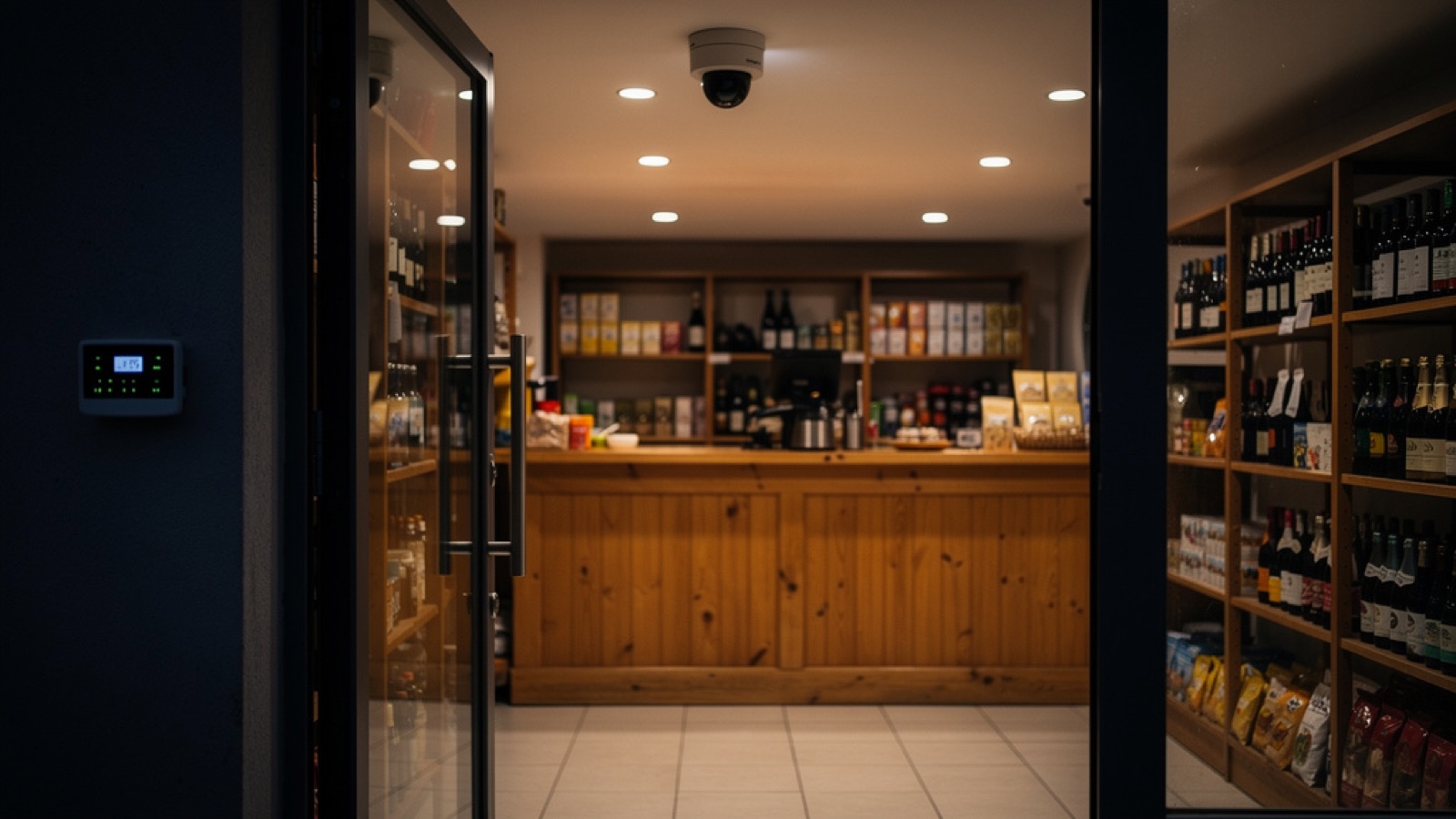
Self-monitored alarms and local-recording cameras for a small retail business. What 'no subscription' really costs, the insurance trap, and when monitoring is worth it anyway. This guide sums up the criteria that matter, the mistakes to avoid and the concrete choices that help you decide faster.
Every small retailer eventually gets the same quote: a commercial alarm system, professionally installed, on a three- or five-year monitoring contract at $50–150 a month. For a business with thin margins, that’s a real line item — and the obvious question follows. Can I get most of the protection without the contract?
Mostly, yes. Self-monitored alarms and local-recording cameras have improved enormously, and for a lot of small shops a no-contract setup is a legitimate choice.
But there are two things the “no subscription” pitch skips, and for a business — unlike a home — they can be expensive. One is that you become the response. The other is that your commercial insurance may have an opinion about it. Both are covered below, before the shopping list.
”No subscription”: what it actually means
The phrase covers three quite different things, and conflating them is where people get caught out.
No monitoring contract. Nobody at a central station watches your alarm. When it triggers, the siren sounds locally and your phone gets a notification — and then you decide what to do. This is the real meaning of “self-monitored,” and it’s a legitimate model.
No cloud subscription. Footage records to a local NVR or SD cards instead of a vendor’s servers. Saves $10–50 a month, and for a business with several cameras that adds up fast. Genuinely worth doing.
No recurring cost at all. This one is close to fiction. Even a fully self-monitored setup usually has a cellular SIM for backup communication ($5–15/month), plus your city’s alarm permit — many US municipalities require registering an alarm system, with an annual fee and escalating fines for false alarms. Budget for these or they surprise you.
The 3 building blocks of a protected store, no contract
1. The perimeter — where money is best spent first
For retail, mechanical protection outperforms electronics per dollar, because most attacks are smash-and-grab attempts against a specific weak point:
- The front glass. The classic attack. Security film (8 mil minimum, with edge attachment) costs a few hundred dollars for a storefront and turns a one-blow entry into a prolonged, loud, visible attack. If you fit one thing, fit this.
- A roll-down grille or shutter. The strongest single deterrent for street-level retail, and often required by landlords or insurers in certain districts.
- The back door. Almost always the real weak point — steel door, reinforced frame, a graded deadbolt, and hinge protection if it opens outward. Same reasoning as securing a front door.
- The rear/alley area. Lighting and clear sightlines. A back door in a dark alley is the entry point nobody sees.
- The register. Empty it nightly, leave the drawer open and visible so nobody breaks glass to check, and use a drop safe for cash during the day. See choosing a safe — the same grading logic applies commercially.
2. The alarm — local siren plus self-monitoring
Without a central station, the alarm has two jobs: make enough noise to end the attempt, and tell you immediately.
- A loud external siren with a strobe, sited where it can be heard from the street. In retail this is doing most of the work — a smash-and-grab depends on being finished in under a minute.
- Cellular backup, so cutting the internet doesn’t silence it. Same principle as alarms with no Wi-Fi.
- A backup battery in the panel, because the power gets cut too.
- Push alerts to two or three people, not just the owner. One phone on silent shouldn’t be a single point of failure.
- Glass break sensors on the storefront, not just door contacts — a smashed window may never open a door.
3. The cameras — local recording, no cloud fee
For a store, cameras serve three purposes: deterrence, evidence for police and insurance, and — the one owners underestimate — internal loss.
- A PoE NVR system with 4–8 cameras is the standard no-subscription answer. One cable per camera carries power and video, everything records to a local hard drive, no monthly fee. Figure $400–1,200 for a decent kit.
- Cover four things: the entrance (faces at eye height, not overhead), the register, the stockroom door, and the rear exit. That’s the order.
- Get the register camera right. Angle it to see hands, the drawer and the customer simultaneously. This is the single most valuable camera in any retail installation.
- Use surveillance-grade drives in the NVR, and if the cameras have SD cards, high-endurance ones.
- Protect the recorder. An NVR sitting in plain sight gets taken along with everything else. Lock it in a cabinet or a back office, and if it matters, add off-site backup of key clips.
- Post visible notice. Beyond deterrence, signage that recording is in progress is expected practice, and some states have specific requirements around audio recording in particular. Video in customer areas is standard; never in restrooms or changing areas.
Comparing setups for a small store in 2026
| Component | No-contract option | Up-front | Recurring |
|---|---|---|---|
| Alarm | Self-monitored wireless panel + external siren | $300–700 | $0–15 (SIM) |
| Cameras | 4–8 channel PoE NVR kit, local recording | $400–1,200 | $0 |
| Glass | 8 mil security film on the storefront | $300–800 | $0 |
| Back door | Steel door, graded deadbolt, hinge protection | $400–1,500 | $0 |
| Cash | Drop safe | $150–500 | $0 |
| Permit | Municipal alarm registration | $0–100 | Varies annually |
Total: roughly $1,500–4,500 up front, and close to nothing per month. Against $50–150/month for a monitored contract, the payback is somewhere between one and four years — which is why this is a real decision rather than an obvious one.
No contract vs professional monitoring: choosing honestly
Self-monitoring is a genuine option for a small shop. It is not the right answer for every one, and the honest comparison looks like this:
| Self-monitored | Professionally monitored | |
|---|---|---|
| Monthly cost | $0–15 | $50–150 |
| Who responds | You, at 3 a.m. | Central station dispatches |
| If your phone is off | Nothing happens | Response is unchanged |
| Insurance | May conflict with a protective safeguards clause | Usually satisfies it, may earn a discount |
| Police response | You call it in | Station calls it in, often with verification |
| Best for | Owner-occupied, lives nearby, low-value stock | High-value stock, absentee owner, insurer requires it |
Choose self-monitoring if: you live close to the store, the stock isn’t high-value or easily fenced, your insurance doesn’t require monitoring, and you’re realistically willing to get up and drive over at 3 a.m.
Choose monitoring if: your policy requires it, the stock is high-value (electronics, pharmacy, jewellery, alcohol, tools), you live far away or travel, or you simply don’t want a break-in to depend on whether you heard your phone.
There’s also a middle path worth knowing: some providers offer monitoring month-to-month with no long contract, at a somewhat higher rate. If the objection is the multi-year commitment rather than the money itself, that’s often the answer.
Quiz: no contract, or monitored?
🏪 Which model fits your store?
4 questions, 30 seconds. The result gives you a direction and a first purchase.
1. Does your insurance require a monitored alarm?
2. How far do you live from the store?
3. What's the stock like?
4. Has the store been hit before?
The loss most owners don’t budget for
One uncomfortable note, because a security article about retail that skips it is incomplete: for most small shops, more inventory is lost to internal shrink and error than to break-ins. Employee theft, sweethearting at the register, receiving errors and administrative mistakes typically add up to more than burglary does.
That doesn’t argue against securing the building. It argues for spending proportionally:
- The register camera and clear till procedures address more actual loss than another perimeter sensor.
- Access control on the stockroom, with individual codes rather than one shared key, tells you who was in there and when.
- Regular inventory counts — small and frequent beats annual and enormous, because they identify a problem while it’s still small.
- A published, evenly applied policy. Most shrink prevention is procedural, not technical.
Our small business security checklist covers the full picture, including the internal side.
Get a free quote within 24 hours from a licensed, UL-certified installer near you — no obligation, zero spam.
Conclusion
A no-contract setup is a legitimate way to protect a small store, and for an owner who lives nearby with moderate-value stock it’s often the better use of money — $1,500–4,500 once, rather than $600–1,800 every year forever.
But make the decision with the two things the marketing leaves out:
Call your insurance broker first. A protective safeguards endorsement requiring a monitored alarm turns “saving $80 a month” into “voiding my theft coverage.” Ask explicitly, and ask what discount a monitored system would earn — sometimes that discount covers most of the fee.
Be honest about who responds. Self-monitored means you, at 3 a.m., possibly on holiday. If that isn’t realistic, you don’t have a self-monitored system — you have a siren and a notification nobody acts on.
And whichever you choose, spend on the perimeter first. Security film on the storefront and a loud external siren cost under $1,000 together and defeat the attack that accounts for most small retail break-ins. Every alarm decision after that is refinement.
For the full picture including access control and internal loss, see our small business security checklist and the roundup of the best business security systems.
Frequently Asked Questions
Can I really run a business alarm with no monthly fee?
Yes — a self-monitored panel sounds a local siren and pushes alerts to your phone with no central station involved. Two caveats: you should still budget a few dollars a month for a cellular SIM so cutting the internet doesn’t silence it, and many municipalities charge an annual alarm permit fee. So “no monthly fee” is really “very low monthly fee.”
Will self-monitoring affect my commercial insurance?
It can, significantly. Many commercial property policies carry a protective safeguards endorsement that conditions theft coverage on maintaining specified protections — often a central-station monitored alarm. Cancelling monitoring while that endorsement is in force can leave you without theft coverage. Call your broker before changing anything; this is the most expensive mistake available here.
What should I spend on first?
Security film on the storefront glass and a loud external siren with a strobe. Together they’re under $1,000 for most small shops and they defeat the smash-and-grab that accounts for most small retail break-ins. Cameras come second, the back door third, a drop safe fourth.
Do I need a permit for an alarm system?
In many US cities, yes — alarm systems must be registered with the municipality or police department, usually for a modest annual fee, and repeated false alarms attract escalating fines. Check your city’s requirements before installation. This applies to self-monitored systems too, not just professionally monitored ones.
Is local NVR recording as good as cloud?
For a store, usually better. You get full-resolution continuous recording with no monthly fee, which matters when you have six or eight cameras. The weakness is that a thief who takes the recorder takes the evidence — so lock the NVR in a cabinet or back office, and consider off-site backup of key clips. Use surveillance-rated drives, not desktop ones.
Where can I legally put cameras in my store?
Video in customer and stock areas is standard practice, with visible notice that recording is taking place. Never in restrooms or changing areas. Audio is treated differently from video and several states require all-party consent to record conversations, so many retailers simply disable audio. If you’re recording employees, tell them in writing as part of your policies.
Is there a middle option between contract and no contract?
Yes, and it’s underused. Several providers offer professional monitoring on a month-to-month basis with no multi-year commitment, at a somewhat higher monthly rate. If your objection is being locked into three or five years rather than the cost itself, that’s usually the right answer — you keep the response and the insurance compliance without the lock-in.
Sources and references
- FBI Crime Data Explorer — Burglary statistics — official U.S. data including non-residential burglary.
- Insurance Information Institute — commercial property coverage, protective safeguards and business theft claims.
- UL Solutions — alarm system certification and central-station standards.
- U.S. Small Business Administration — guidance on business loss prevention and risk management.
