

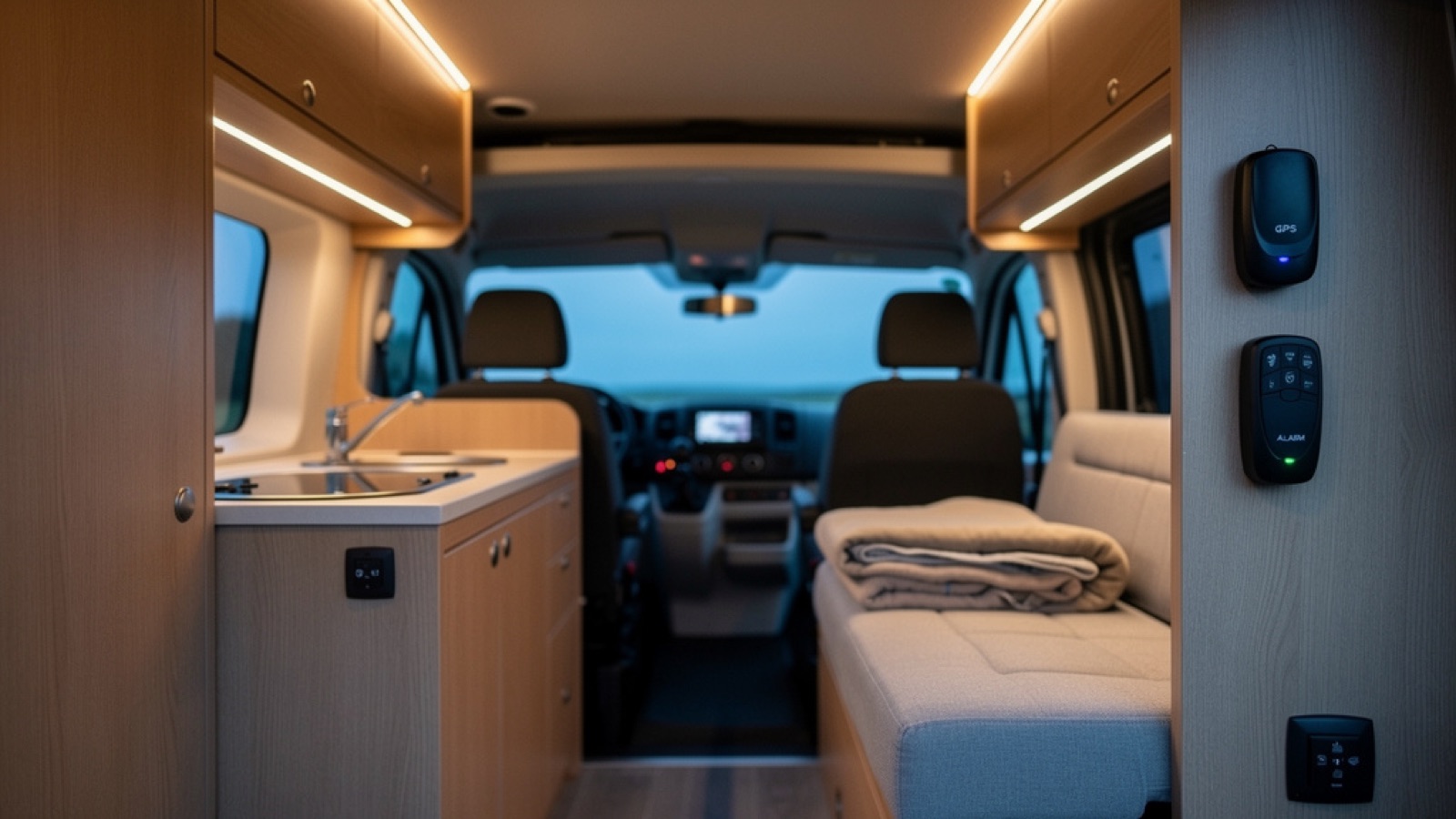
Theft of the RV and theft from the RV are different problems. GPS trackers, hitch and wheel locks, alarms — what to fit first, and what actually gets a vehicle back. This guide sums up the criteria that matter, the mistakes to avoid and the concrete choices that help you decide faster.
An RV is a strange security problem: it’s a vehicle, a house, and a storage unit at once, and it spends most of the year parked somewhere you aren’t. Nine or ten months in a storage lot, a driveway, or a side street — and then a few weeks in a campground where the whole point is being somewhere unfamiliar.
Most owners protect it the way they’d protect a car. That’s the wrong model, because two entirely different crimes are in play, and the countermeasures for one do almost nothing for the other.
The 2 risks to separate (they don’t call for the same answers)
Risk 1: theft of the vehicle
Whole-unit theft is the low-frequency, high-severity case. It happens most often at storage lots and long-term parking, where a rig sits unwatched for weeks and nobody knows what “normal” looks like.
- Travel trailers and towables are the easiest targets: no ignition to defeat, just a coupler to drop onto a ball. A trailer can be gone in under two minutes.
- Motorhomes are harder — a modern engine needs the key or a relay attack — but they’re also driven away in plain sight, which attracts less attention than you’d expect.
- Recovery is the whole game. A stolen RV is large, slow, and hard to hide. That’s why a GPS tracker is disproportionately effective here compared with a car.
Risk 2: theft from the vehicle
Far more common, lower severity, and what most owners will actually experience. The rig gets broken into for what’s inside: bikes on the rear rack, generators, the TV, tools, propane tanks, the lithium house batteries, and increasingly, catalytic converters from underneath.
- RV entry doors are weak. Many use lightweight, standardized locks; a whole category of RV locks historically shared a small number of key codes.
- Compartment doors (“basement” bays) are weaker still — flat keys, thin latches, often the same key across every bay.
- Break-in usually happens where you’re staying, not in storage: campgrounds, trailheads, rest stops, city street parking overnight.
The rest of this guide is layered by which risk it addresses. Do layer 1 regardless of anything else.
Layer 1 — The GPS tracker (the absolute priority)
If you buy one thing, buy this. It’s the only item on the list that changes the outcome after the theft, and for a vehicle this large and slow, that’s usually a recovery.
Hardwired or battery?
| Type | Power | Update rate | Pros | Cons |
|---|---|---|---|---|
| Hardwired (12 V) | Vehicle battery | Frequent, always on | Never needs charging, can trigger on ignition | Requires install; findable if the thief traces wiring |
| Battery, magnetic | Internal, 3–12 months | Wakes periodically | Hide anywhere, no install, second unit as backup | You must remember to recharge it |
| OBD-II plug-in | OBD port | Frequent | Thirty-second install | First place a thief looks — use as a decoy, not the real one |
The right answer is two trackers. One hardwired or obvious-ish, and one hidden battery unit somewhere non-obvious that a thief won’t find in a hurry — inside a cabinet void, behind a panel, in the roof structure. The first may be found and pulled; the second is what actually recovers the vehicle.
What to look for
- A cellular subscription you can actually keep alive — most trackers need a data plan, typically $5–15 a month. A lapsed plan is a dead tracker.
- Geofence alerts. The single most useful feature: get a notification the moment the vehicle leaves the storage lot. That’s what turns a week-late discovery into a same-hour police report.
- Motion/tow detection for a parked trailer.
- Battery life you’ll realistically maintain — a 6-month battery you recharge at the start and end of each season is better than a 30-day one you’ll forget.
Layer 2 — Mechanical locks (visible deterrence)
A mechanical lock will not stop a determined, equipped thief. That is not its job. Its job is to make your rig the harder one in the row, from thirty feet away, in three seconds of assessment. Visibility is the feature.
| Device | Protects against | Typical price | Notes |
|---|---|---|---|
| Wheel lock / boot | Driving or towing away | $80–250 | The most visible deterrent there is |
| Coupler / hitch lock | Hooking up a trailer | $30–90 | Essential on any towable; get a shrouded design |
| King pin lock | Fifth-wheel theft | $50–150 | The fifth-wheel equivalent of a coupler lock |
| Steering wheel lock | Driving a motorhome away | $30–80 | Cheap, unmistakable from outside |
| Upgraded door/bay locks | Break-in | $25–120 | Replaces the factory locks and their shared key codes |
| Catalytic converter shield | Underside cutting | $100–300 | Worth it on high-clearance motorhomes and vans |
Layer 3 — Alarm and interior camera
For break-in protection and remote awareness while the rig is stored or you’re away from it:
- A standalone battery alarm on the entry door. $25–60, no wiring, 110 dB. In a quiet storage lot or a campground at 3 a.m., that is often the whole intervention.
- Motion sensors inside, on a small self-contained system, if the RV holds valuable gear over winter.
- An LTE camera with a battery. RVs in storage have no Wi-Fi and no power — the same problem as a remote shed. A cellular camera with a solar panel solves it; see our guide to cameras with no Wi-Fi and no power.
- A “12 V disconnect” habit. Some owners pull the battery disconnect and a fuse when storing a motorhome long-term. It won’t stop a tow, but it takes drive-away off the table for an opportunist.
Quiz: where should you start?
🚐 What does your rig need first?
4 questions, 30 seconds. The result gives you the priority order.
1. What type of rig is it?
2. Where does it live most of the year?
3. How often do you physically check on it?
4. What's stored inside over the off-season?
The free habits that change everything
Hardware is half of it. These cost nothing:
- Photograph the VIN and every serial number — chassis, appliances, generator, batteries, bikes. Store it in the cloud, not in a folder inside the RV.
- Never leave the registration or title inside. It’s an ownership document sitting in an unattended vehicle.
- Vary the parking angle and position in a storage lot when you can. A rig that hasn’t moved in four months announces itself.
- Choose the storage lot on cameras and access control, not on price. Ask what happens on a gate code at 2 a.m., and whether footage is actually retained.
- Don’t post the storage location. Geotagged photos of “putting her away for the winter” are exactly the reconnaissance a thief would otherwise have to do themselves.
- Empty it over winter. Bikes, electronics, tools, and the generator. The contents are worth more than most owners realize, and an empty rig is a far less interesting target.
- Check your insurance for a “stored” endorsement. Many policies reduce coverage while a unit is in storage; some require a specific type of lot.
- On the road: park with the entry door visible to the campground road or your own sightline, not facing the woods. Same principle as a home’s weak points — cover is what the thief needs.
Get a free quote within 24 hours from a licensed installer near you — no obligation, zero spam.
Conclusion
An RV inverts normal vehicle security. It’s parked and unwatched most of the year, it’s a house full of contents, and — crucially — it’s large, slow, and hard to conceal once stolen. That last fact is why the priority order looks the way it does:
- A GPS tracker with geofence alerts, and a second one hidden. Recovery is realistic for a vehicle this size, but only if you know it’s gone within the hour.
- A visible mechanical lock — wheel lock, coupler lock, king pin lock, or steering wheel lock depending on the rig. It doesn’t have to be unbeatable. It has to make the next rig in the row look easier.
- Upgraded door and compartment locks, because the factory ones were never a security product.
- A battery siren and, where it makes sense, an LTE camera so an attempt doesn’t go unnoticed for six weeks.
Layers 1 and 2 together run about $200–400 plus a few dollars a month. Against a $40,000–150,000 asset that spends most of its life alone in a parking lot, that’s not a hard calculation.
For the property side of the equation — securing the house while the rig is out, or the driveway while it’s home — see preventing burglary while on vacation and securing your yard and outdoor spaces.
Frequently Asked Questions
What's the single best anti-theft device for an RV?
A GPS tracker with geofence alerts. Locks buy minutes; a tracker is the only thing that helps once the vehicle is actually gone — and because an RV is large, slow, and hard to hide, recovery rates are meaningfully better than for a car. Fit two if you can: one obvious, one deeply hidden.
Are RV door locks really that weak?
Historically yes. Standard RV entry and compartment locks have been keyed alike across enormous numbers of units, meaning another owner’s key may open your doors. Replacing them with keyed-different aftermarket locks costs $25–60 per door and takes about fifteen minutes each. It’s the highest-value upgrade most owners have never heard of.
Is a wheel lock worth it if a thief can cut it off?
Yes, because that’s not what it’s for. A wheel lock is a visible signal, assessed in seconds from a distance, that says this rig is more work than the one beside it. It buys time and it redirects the choice. Pair it with a tracker so you’re covered on both deterrence and recovery.
How do I protect a trailer in a storage lot with no power?
A long-life battery GPS tracker with a geofence, a coupler lock and a wheel lock, and a standalone battery door alarm. For video, an LTE camera with a solar panel — check whether the lot permits it. And pick the lot on its cameras, gate control, and footage retention rather than its monthly rate.
Should I worry about catalytic converter theft?
On a motorhome or camper van, yes — the clearance that makes them easy to work under is the same clearance a thief likes. A welded shield or cage costs $100–300 installed and makes the job slow and loud. Trailers without an engine aren’t exposed to this one.
Does my auto or RV insurance cover contents?
Often only partially, and frequently under a sublimit that doesn’t cover bikes, electronics, or lithium batteries. Some policies also change coverage while the unit is in storage, or require a particular type of lot. Read the declarations before the season, not after an incident, and photograph serial numbers regardless.
What's the best place to hide a GPS tracker?
Somewhere with a view of the sky and cellular signal, that isn’t the first place anyone looks. Not the OBD port, not the glovebox, not clipped under the bumper. A cabinet void, behind an interior panel, or in the roof structure works well. Whatever you choose, test it in place and confirm the app reports the correct position before you rely on it.
Sources and references
- FBI Crime Data Explorer — Motor vehicle theft — official U.S. vehicle theft statistics.
- National Insurance Crime Bureau (NICB) — vehicle theft trends, recovery rates and catalytic converter theft data.
- NHTSA — Vehicle theft prevention — federal guidance on anti-theft devices.
