

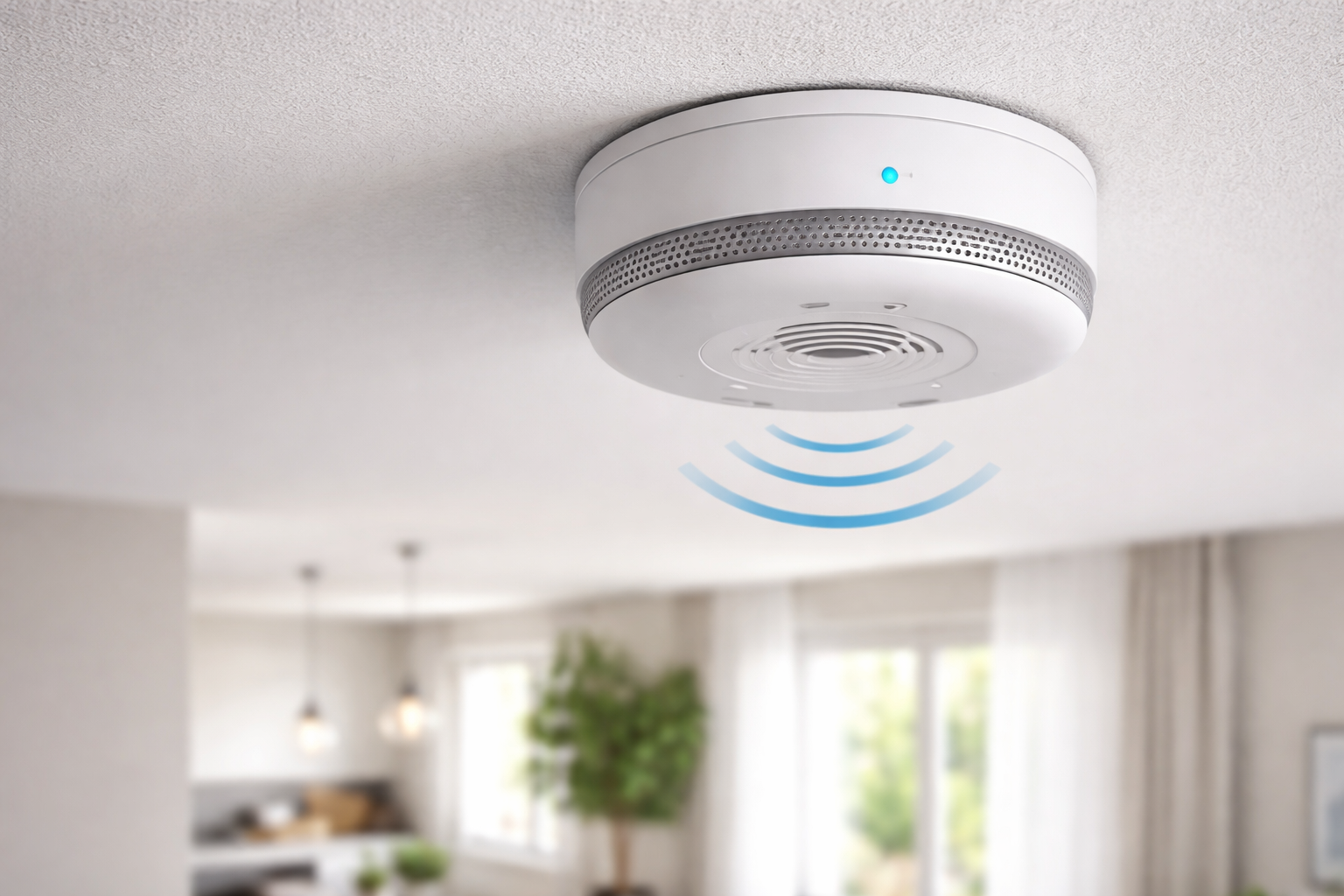
Hardwired with backup, replaceable battery or 10-year sealed? What the IRC requires, which states mandate sealed batteries, and when you need an electrician. This guide sums up the criteria that matter, the mistakes to avoid and the concrete choices that help you decide faster.
The most dangerous smoke alarm I find on home visits isn’t a cheap one. It’s a good alarm whose battery is sitting on top of the fridge. Somebody burned toast, the alarm screamed, the battery came out “just for tonight” — and months later the family is sleeping under a plastic disc that can’t make a sound.
In fifteen years assessing homes, that pattern explains most of what goes wrong with battery alarms. Hardwired alarms are measurably more reliable, but 10-year sealed-battery alarms with wireless interconnection get most existing homes most of the way there — without opening a wall. Below: the three power options, what the code requires, which states mandate sealed batteries, and when you need an electrician. For how many alarms you need and where, see our guide to where to place smoke detectors.
The quick answer
Hardwired smoke alarms (120 V household power with a battery backup) are the more reliable option and are what the International Residential Code requires in new homes. In NFPA’s analysis of 2018–2022 U.S. home fires, hardwired alarms operated in 94% of fires large enough to trigger them, versus 85% for battery-only alarms, and most battery-alarm failures came from missing, disconnected or dead batteries. In an existing home without alarm wiring, 10-year sealed-battery alarms with wireless interconnection are the practical upgrade, and the code accepts battery-powered alarms in permitted remodels. The one move never to make: replacing a hardwired alarm with a battery-only unit.
The three power options
Hardwired 120 V with battery backup
The alarm is wired into a household circuit, usually through a plug-in harness on a ceiling box. House power runs it; a backup battery keeps it alive in an outage. That backup is either a replaceable 9 V or AA cell — which the U.S. Fire Administration says to replace once a year — or a sealed 10-year lithium cell built in for the alarm’s whole life (Kidde’s i12010S is one example). Hardwired systems are also where wired interconnection lives: a dedicated interconnect wire, often called the traveler, runs between alarms so that when one sounds, they all do.
Battery-only with replaceable 9 V or AA cells
No wiring: screw a base to the ceiling and you’re done. The cheapest, easiest option — and the one most likely to be silenced by a human. Fit a fresh battery at least yearly and replace the alarm 10 years from its manufacture date.
10-year sealed lithium
Still battery-only, but the battery is sealed in. Near the end of its life the alarm chirps and you replace the whole unit. No yearly battery, nothing to “borrow” for the TV remote, and a hush button for burnt toast instead of a tempting battery door. Many models offer wireless interconnection.
Hardwired vs battery: side by side
| Criteria | Hardwired 120 V + backup | Battery (replaceable 9 V / AA) | 10-year sealed lithium |
|---|---|---|---|
| Install cost & effort | Highest for new locations (new wiring, usually an electrician, often a permit); low for a like-for-like swap on an existing harness | Lowest — two screws, minutes per alarm | Low — same install; higher unit price than basic models |
| Reliability (NFPA, 2018–2022) | Operated in 94% of fires large enough to trigger an alarm | Battery-only alarms operated in 85%; battery problems drove most failures | Counted with battery-only in NFPA data; built to remove the missing/dead-battery failure |
| Interconnect | Wired interconnect standard; some models add wireless | Only on wireless-interconnect models | Wireless on many models |
| Maintenance | Test monthly; replace backup yearly unless sealed; new unit at 10 years | Test monthly; new battery at least yearly; new unit at 10 years | Test monthly; no battery changes; new unit at end of life |
| Best for | New builds, major remodels, homes already wired | Stop-gap coverage only | Existing homes without wiring, renters, filling gaps |
Two more figures from that NFPA report explain why I push sealed batteries. Battery-only alarms were present in 44% of reported home fires with alarms, yet those fires accounted for 66% of the deaths in homes with smoke alarms. And when battery-only alarms failed, 42% had a missing or disconnected battery and 32% a dead one. Even in hardwired systems with backup, the most common failure was a missing or disconnected backup battery (27%). The weak point is the battery someone can remove.
Interconnection: wires vs radio
Interconnection matters more than the power source: a basement alarm is useless if nobody behind closed bedroom doors upstairs hears it.
- Hardwired interconnect uses the traveler wire — robust, no pairing, but only where someone ran it.
- Wireless interconnect links alarms by radio, in battery-only alarms and in hardwired alarms with a built-in radio link (handy for a room the wiring doesn’t reach). The IRC accepts listed wireless alarms, provided all of them sound when one activates.
Two rules I give every client. Stay within one brand’s system — First Alert warns against putting Kidde and First Alert units on the same interconnect wire, because the signals differ and whole-home alerts may fail. And replace interconnected alarms together.
What the building code requires
Most states and cities base their residential rules on Section R314 of the International Residential Code (IRC), usually with local amendments, so your building department has the final word. In the 2021 edition:
New construction
- R314.2.1 requires smoke alarms in new dwelling units, in the R314.3 locations: each bedroom, outside each sleeping area, and every story including basements.
- R314.6 (power source) requires primary power from the building wiring when the home has commercial power, with a battery when that power is interrupted, on permanent wiring with no switch other than overcurrent protection. In short: new homes get hardwired alarms with battery backup.
- R314.4 (interconnection) requires the alarms to be interconnected so one activates all; physical wiring isn’t needed where listed wireless alarms all sound together.
Remodels and additions
Under R314.2.2, permitted alterations, repairs or additions trigger new-construction alarm locations for the whole dwelling (exterior work and plumbing or mechanical work are exempt). Crucially, R314.6 Exception 2 lets those alarms be battery-powered, and wireless interconnection satisfies R314.4 — the code-sanctioned path for older homes, no walls opened.
Existing homes (no permit work)
The IRC doesn’t force an existing home to rewire, but state laws and fire codes for existing dwellings vary. Maryland’s State Fire Marshal states a principle worth following everywhere: sealed battery alarms go where battery alarms already exist or where there are none — never in place of required wired-in alarms.
States that require 10-year sealed batteries
The ones I’ve verified:
- California — since July 1, 2014, solely battery-powered smoke alarms must contain a non-replaceable, non-removable battery rated for at least 10 years (Cal. Code Regs. tit. 19, §208). Alarms using low-power radio for interconnection are exempt.
- New York — since April 1, 2019, new or replacement smoke alarms offered for sale must be hardwired or use a sealed, non-removable 10-year battery. Existing compliant alarms don’t have to come down.
- Illinois — since January 1, 2023, newly installed alarms in single- and multi-family homes must have a 10-year sealed battery, with exemptions including homes built after 1988 with hardwired alarms and wireless-integrated systems.
- Maryland — since July 1, 2013, a battery-only alarm over 10 years old must be replaced with a sealed 10-year long-life unit with a silence/hush button, and every alarm must be replaced 10 years from its manufacture date.
Other states and cities have their own rules; check with your state fire marshal.
Renters vs owners
If you own, keep any hardwired alarms you have, replace them like-for-like when they expire, and fill gaps with sealed or wireless-interconnect units.
If you rent, alarms are generally the landlord’s responsibility, with details set by state law. In California, for example, rental owners must test and maintain smoke alarms, and tenants must tell the owner or manager when one doesn’t work. Don’t touch the wiring, report a dead or chirping unit in writing, and if you add a sealed battery alarm in your bedroom, check the lease first — it supplements the required alarms, it doesn’t replace them.
When you need an electrician — and when a swap is DIY
The U.S. Fire Administration says hardwired alarms should be installed by qualified electricians; manufacturers design replacements to plug into the existing harness. Here’s how I split it.
Usually a straightforward like-for-like swap:
- Replacing a harness-mounted alarm with a current model from the same brand — modern First Alert/BRK alarms plug straight into older BRK three-wire harnesses.
- Switching brands with the manufacturer’s adapter plug, which mates the old harness to the new alarm without stripping wires (Kidde’s KA-B3 for select First Alert/BRK harnesses; First Alert’s ADK-12 for Kidde harnesses). These adapters aren’t universal — check your exact model numbers against the compatibility list.
- In every case: switch off the breaker feeding the alarm circuit first, and afterwards press test and confirm every interconnected alarm sounds.
Call an electrician when:
- You want a hardwired alarm where there’s no box or wiring, or need to extend the interconnect — that’s new wiring, and in many jurisdictions a permit.
- The old alarm is spliced to the house wires with no harness, the connector looks scorched, or you can’t identify the breaker.
- The alarms are tied into a monitored fire alarm panel.
And never replace a hardwired alarm with a battery-only one: you lose house power and usually the interconnect.
Which setup fits your home?
🔌 Hardwired, sealed battery, or both?
4 quick questions. The higher your score, the more a hardwired system makes sense.
1. Do you own or rent your home?
2. Are your current alarms wired in (mounted on a ceiling box with a plug-in harness)?
3. Are you planning work that opens walls or ceilings, or needs a permit?
4. Is there easy access above or below the rooms (open attic or unfinished basement)?
Smart alarms: Nest Protect wired vs battery
Google’s Nest Protect is the best-known smart alarm: the wired model runs on 120 V with three AA lithium cells as backup, the battery model on six AA lithium cells, and both interconnect wirelessly — which is why the battery Protect, despite replaceable cells, can be used in California and New York.
One update before you buy: Google stopped making Nest Protect in March 2025. Existing units remain supported, and Google now points U.S. buyers to First Alert’s SC5 smart smoke and CO alarm — sold in hardwired and battery versions — which works in the Google Home app and interconnects with existing Protects. See our hands-on Google Nest Protect review, our best smoke detectors guide or the smoke detectors hub — and since sensor type matters as much as power, photoelectric vs ionization smoke detectors.
Get a free assessment within 24 hours from a licensed pro near you — alarms, detectors, entry points. No obligation, zero spam.
Conclusion
Hardwired alarms with battery backup are the gold standard and the code baseline for new homes. But the bigger risk in most homes is a removable battery that someone removed, and alarms that can’t hear each other. Already wired? Stay wired and replace like-for-like. Not wired? Use 10-year sealed-battery alarms with wireless interconnection. Leave new circuits to an electrician, check your state’s sealed-battery rules, and never downgrade a hardwired alarm to battery-only. Then press the test button once a month.
Frequently Asked Questions
Are hardwired smoke detectors better than battery ones?
They’re more reliable: in NFPA’s 2018–2022 data, hardwired alarms operated in 94% of fires large enough to trigger them, versus 85% for battery-only alarms, mostly because of missing or dead batteries. A 10-year sealed-battery alarm closes much of that gap — there’s no battery to remove or forget.
Do smoke detectors have to be hardwired?
In new construction, generally yes: IRC Section R314.6 requires primary power from the building wiring with battery backup. For permitted remodels and additions, the IRC allows battery-powered alarms, and listed wireless interconnection satisfies the interconnect rule. Existing homes follow state and local rules, so check with your building department or state fire marshal.
Can I replace a hardwired smoke detector with a battery-operated one?
You shouldn’t. You’d lose house power and usually the interconnection with your other alarms. Maryland’s State Fire Marshal is explicit that required wired-in alarms must never be swapped for battery-only units. Replace hardwired with hardwired, ideally with a sealed 10-year backup.
Can I replace a hardwired smoke detector myself?
A like-for-like swap on an existing plug-in harness is designed to be simple: breaker off, plug in a same-brand replacement (or use the manufacturer’s adapter), power on, and test that every interconnected alarm sounds. New wiring, missing harnesses, damaged connectors or a monitored panel are electrician jobs.
Do hardwired smoke detectors need batteries?
Yes — a backup battery keeps them working in a power outage. Older models use a replaceable 9 V or AA cell to change at least once a year; many current models have a sealed lithium backup meant to last the alarm’s 10-year life. A chirping hardwired alarm usually means a low backup battery or an alarm at end of life.
Which states require 10-year sealed battery smoke alarms?
Among those we verified: California (solely battery-powered alarms, since July 2014), New York (alarms sold since April 2019, unless hardwired), Illinois (new installations since January 2023, with exemptions) and Maryland (expired battery-only alarms must be replaced with sealed 10-year units with a hush button). Other states and cities have their own rules, so check locally.
Sources
- NFPA — Smoke Alarms in US Home Fires (June 2024) — operation rates by power source and failure causes, 2018–2022 data.
- U.S. Fire Administration — Smoke alarms — power types, battery and 10-year replacement, installation by qualified electricians.
- Anne Arundel County, MD — IRC 2021 Section R314 summary — R314.2.2, R314.4 and R314.6 as adopted.
- California Code of Regulations, Title 19, §208 and Health & Safety Code §13113.7 — sealed 10-year battery rule; landlord and tenant duties.
- New York Department of State — residential smoke alarm sales requirements (2019)
- Illinois State Fire Marshal — Illinois smoke alarm law
- Maryland State Fire Marshal — smoke alarm law explanation
- Google Nest Help — Nest Protect sales status and First Alert SC5 — plus manufacturer documentation (Kidde i12010S specifications, First Alert wiring-adapter compatibility guide, Nest Protect technical specifications).
