

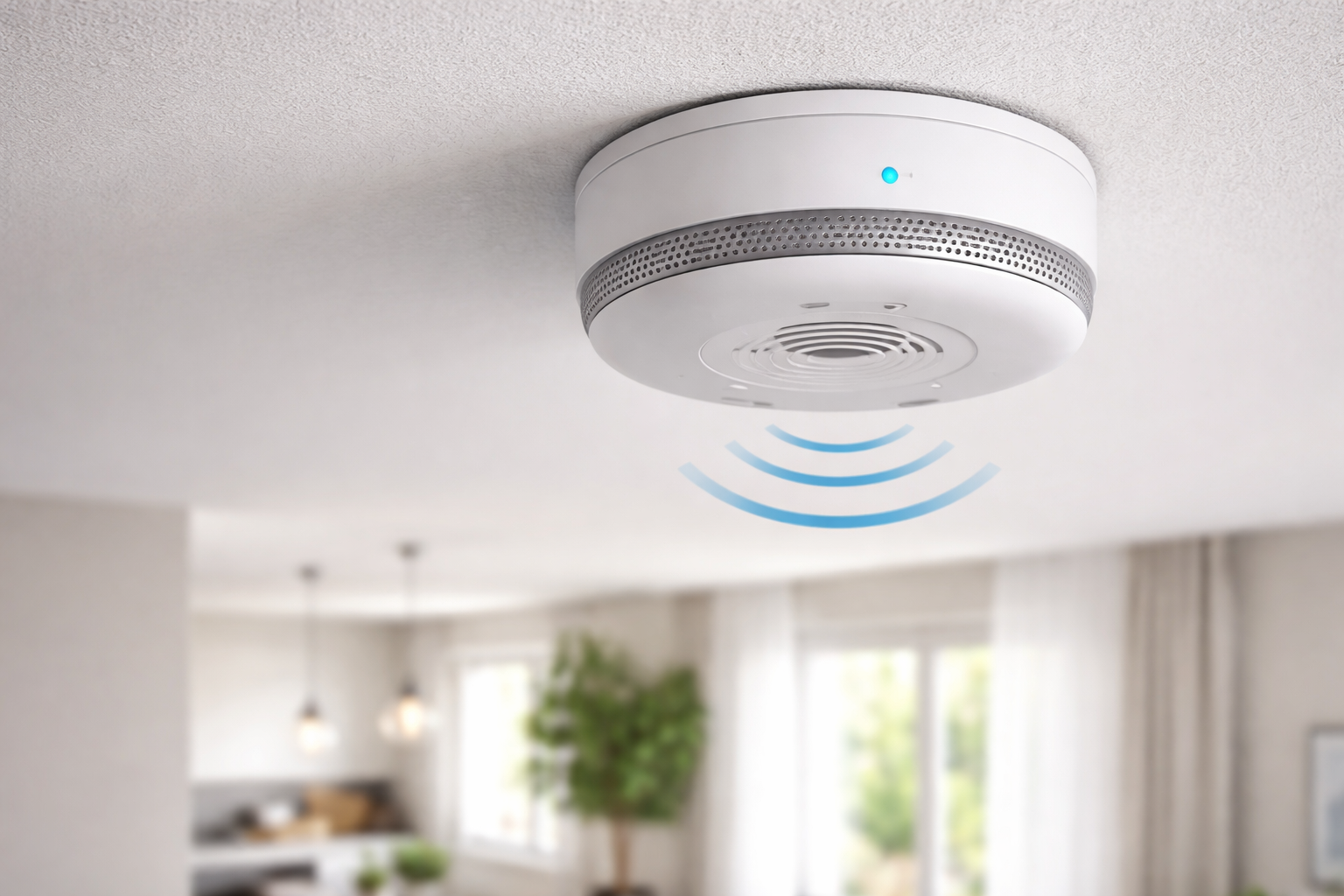
How each sensor works, which fires each catches first, the new UL 217 cooking test, state rules, old-unit disposal, and what to buy for each room. This guide sums up the criteria that matter, the mistakes to avoid and the concrete choices that help you decide faster.
Almost every home I walk into has smoke alarms. What surprises people is how often they’re the wrong kind for the spot they’re in. The classic case is a cheap ionization unit eight feet from the stove. It goes off every time someone sears a steak, so the battery comes out “just for tonight” and never goes back in.
In fifteen years assessing homes, I’ve learned to ask what’s inside the alarms and how old they are, not just whether they exist. Ionization alarms react a little faster to fast, flaming fires. Photoelectric alarms react faster to slow, smoldering fires, often much faster, and they cope far better with cooking. You can’t know in advance which fire you’ll get, so the goal is the right sensor in the right place. This guide shows you how to do that, and what to do with the old units already on your ceiling.
The quick answer
Ionization smoke alarms respond somewhat faster to fast-flaming fires. Photoelectric alarms respond faster to smoldering fires and cause fewer cooking false alarms. Nobody can predict which fire will start, so the U.S. Fire Administration recommends that every home and sleeping area have either both types or dual-sensor alarms. NFPA recommends photoelectric near kitchens and bathrooms and combination alarms for the best protection. When you replace an alarm, choose one certified to the 8th edition of UL 217. That edition took effect on June 30, 2024 and adds a cooking-nuisance test.
If you’re still working out how many alarms you need and where they go, start with our guide on where to place smoke detectors. This article covers which type goes in each spot.
How each sensor works
Ionization: a tiny current that smoke interrupts
An ionization alarm contains a very small amount of radioactive americium-241. The EPA explains that its alpha particles keep a steady flow of ions moving between two charged plates. Smoke disrupts that flow, and the alarm sounds. According to the NRC, most units sold today contain one microcurie or less of americium-241. This design is good at catching the small particles that fast, flaming fires give off. The catch is that cooking fumes trip it easily too.
Photoelectric: a beam of light that smoke scatters
A photoelectric (or “optical”) alarm has a light source and a sensor in a dark chamber. Smoke that drifts in scatters the light onto the sensor, which sets off the alarm. There’s no radioactive material involved. It picks up the thick smoke of a smoldering fire well, such as a cigarette in a couch cushion or wiring that is slowly charring. That kind of fire can fill a house with toxic smoke before any flames appear.
Dual-sensor and multi-criteria alarms
- Dual-sensor alarms put an ionization sensor and a photoelectric sensor in one housing.
- Multi-criteria alarms combine more than one sensing input and judge the combined signal. NFPA notes that these newer models say “helps reduce cooking nuisance alarms” on the packaging, and it suggests them when you replace existing alarms.
Which fires each type catches first
The most-cited U.S. data comes from NIST’s full-scale home smoke alarm tests, which burned real furnishings in residential settings. NIST found that:
- Ionization alarms responded somewhat better to flaming fires.
- Photoelectric alarms responded often considerably faster to smoldering fires.
- Either type consistently gave occupants time to escape from most residential fires, though sometimes not much time.
- Escape times were systematically shorter than in a similar 1970s study.
That last point is why the standards changed. In 2024, NIST noted that modern sofa cushions are often filled with polyurethane foam, which burns more quickly than the cotton or horsehair used in the first alarm tests. Fires grow faster now, so an alarm that is slow on a whole category of fire is a real gap.
Nuisance alarms and the new UL 217 cooking test
UL notes that nuisance alarms are a common reason people pull batteries or disconnect power, and then forget they did. NFPA’s guidance is direct: photoelectric alarms are the best type near kitchens and bathrooms, and every smoke alarm should be at least 10 feet (3 m) from the stove.
What changed in UL 217, 8th edition
The 8th edition of UL 217 (home smoke alarms) and the 7th edition of UL 268 (system detectors) took effect on June 30, 2024. They added three tests:
- Flaming polyurethane foam. The alarm must detect a fast furniture-foam fire.
- Smoldering polyurethane foam. The alarm must detect a slow, smoky one.
- Cooking nuisance. Two standardized hamburger patties are broiled about 10 feet away, and the alarm must not go off.
When NIST ran 45 older alarms through these tests in 2016, none passed. The cooking test isn’t magic, though. In NIST’s 2024 kitchen-lab work, the new alarms weren’t universally better at ignoring cooking smoke, and the researchers called the results “a mixed bag.” Their overall verdict was still positive: the new alarms detect more types of fire without increasing nuisance alarms.
What the fire code says about kitchens
NFPA 72 (2022 edition, as amended by TIA 22-4) sets two rules for alarms near cooking appliances:
- No smoke alarm within 10 ft of a fixed cooking appliance. Open-plan layouts get a narrow exception for 6–10 ft, but only for alarms listed for cooking-nuisance resistance.
- Between 10 and 20 ft, alarms installed from January 1, 2025 must be listed for cooking-nuisance resistance under UL 217, 8th edition (or later).
Codes apply where your state or city has adopted them, so check locally. Either way, the alarm nearest your kitchen should be photoelectric, and ideally an 8th-edition model.
Dual-sensor alarms: the best of both?
The U.S. Fire Administration recommends “both ionization and photoelectric smoke alarms, or dual sensor smoke alarms,” and NFPA recommends interconnected combination alarms. A dual-sensor unit meets that with one device per spot, which suits bedrooms, hallways and basements.
The trade-off is that it still contains an ionization sensor, so it isn’t the right pick within about 20 feet of a kitchen or full bathroom. Massachusetts, for example, calls for photoelectric in that zone. Near a nuisance-prone area, an 8th-edition multi-criteria alarm is the cleaner answer.
Where the law requires photoelectric
I’ve listed only the rules I could check against the statute or the enforcing fire department. Cities and counties often add their own rules, so confirm with your local fire marshal, especially before a sale or a rental.
- Massachusetts: the Boston Fire Department’s chart for one- and two-family homes shows photoelectric only within 20 feet of a kitchen or full bathroom for almost every construction era. Homes built or substantially modified since February 1, 2011 must use photoelectric throughout. Older homes have other options outside the 20-foot zone, depending on the year they were built.
- Maine: detectors installed or replaced within 20 feet of a kitchen or a bathroom with a tub or shower must be photoelectric. Ionization is still allowed inside bedrooms (25 MRSA §2464).
- Vermont: new single-family homes, and single-family homes being sold, need smoke alarms that are “photoelectric-type or UL 217 compliant” near the bedrooms and on each level, plus CO alarms (9 V.S.A. §2882).
- A caution on Iowa: older lists say Iowa requires dual-sensor alarms. The current state fire marshal rule requires alarms listed to UL 217, and existing dual-sensor units may stay until they fail or the manufacturer says to replace them.
Photoelectric vs. ionization vs. dual vs. multi-criteria at a glance
| Type | Fastest at | Cooking nuisance | Radioactive source | Best spot |
|---|---|---|---|---|
| Photoelectric | Smoldering fires | Lower; NFPA's pick near kitchens & baths | No | Near kitchens & baths, and anywhere else |
| Ionization | Fast-flaming fires | Higher near cooking | Yes (americium-241) | Far from kitchens & baths only |
| Dual-sensor | Both fire types | Still has an ionization sensor | Yes | Bedrooms & halls away from the kitchen |
| Multi-criteria (UL 217 8th ed.) | Flaming & smoldering (new tests) | Must pass the hamburger test | Check the label | Anywhere; the default when replacing |
Which type to buy, room by room
- Hallway outside the bedrooms: your most important alarm. Use a dual-sensor or 8th-edition multi-criteria unit. If the hallway is within 20 feet of the kitchen or a bathroom, use photoelectric.
- 10–20 ft from the kitchen: photoelectric, ideally listed to UL 217 8th edition. Nothing within 10 ft of the stove. Inside the kitchen itself, use a heat alarm.
- Bedrooms: photoelectric at minimum. A dual-sensor unit works well if the room is away from the kitchen and bathrooms.
- Next to a bathroom: photoelectric, because shower steam is a classic nuisance trigger.
- Basement and living areas: dual-sensor or multi-criteria, since you can’t predict the fire type in these spaces.
- Garage: a heat alarm, not a smoke alarm.
Whatever you choose, interconnect the alarms so a fire downstairs also sets off the one next to the bed.
For specific models, including interconnected and smart options, see our best smoke detectors comparison and our Google Nest Protect review. If you’re also deciding on power, read hardwired vs. battery smoke detectors.
Quiz: are your alarms the right type?
🚨 Is the right sensor in the right place?
4 quick questions. Check the label on the back of your alarms if you're unsure.
1. What type is the alarm closest to your kitchen?
2. How often does cooking set off an alarm?
3. Are bedrooms and hallways covered by both technologies?
4. How old are your alarms (date on the back)?
What to do with old ionization alarms
Check what you have. Take the alarm down and read the label on the back. Ionization units state that they contain radioactive material, usually americium-241. Also note the manufacture date: NFPA says every smoke alarm, whatever its type, must be replaced 10 years after that date. If a unit keeps chirping after a fresh battery, it has reached end of life. See smoke detector chirping and when to replace.
Is it dangerous? Not while it’s intact. The EPA says ionization detectors pose no health threat as long as they’re undamaged and used as directed. The NRC adds that americium’s alpha particles are a hazard only if taken into the body.
How to dispose of it:
- Install the replacement first. Never leave a room without a working alarm, even overnight.
- Don’t open, crush or tamper with the old unit. The EPA warns that tampering could damage the shielding around the source.
- Remove any replaceable battery and recycle it under your local rules.
- Check local rules, then dispose. The EPA says there are no special disposal instructions. Ionization detectors can go in household trash, or into a community recycling program if your area has one. Some cities and manufacturers run take-back programs, so check your local waste authority first.
Get a free assessment within 24 hours from a licensed pro near you — alarms, detectors, entry points. No obligation, zero spam.
Conclusion
Each sensor is faster at a different kind of fire, so there’s no single winner. Photoelectric catches smoldering fires sooner and tolerates cooking. Ionization is slightly quicker on flaming fires but more prone to nuisance alarms. Use photoelectric near the kitchen and bathrooms, put dual-sensor or multi-criteria alarms where people sleep, and buy a UL 217 8th-edition model whenever a unit turns ten. Then test every alarm monthly.
Frequently Asked Questions
Is photoelectric or ionization better?
Neither wins everywhere. In NIST’s tests, ionization responded somewhat faster to flaming fires, while photoelectric responded often considerably faster to smoldering fires and caused fewer cooking false alarms. NFPA and the USFA recommend having both technologies, with photoelectric near kitchens and bathrooms.
Which smoke detector is best near a kitchen?
Photoelectric, ideally listed to UL 217 8th edition. Keep every smoke alarm at least 10 feet from the stove. Under NFPA 72, alarms installed 10–20 feet from a cooking appliance from January 1, 2025 must be listed for cooking-nuisance resistance. Use a heat alarm inside the kitchen itself.
Are dual-sensor smoke alarms worth it?
Yes, for bedrooms, hallways and basements away from the kitchen. They meet the USFA recommendation in one unit. Because they still contain an ionization sensor, use photoelectric instead within about 20 feet of a kitchen or full bathroom.
What is the UL 217 8th edition?
It’s the current U.S. standard for home smoke alarms, in effect since June 30, 2024. It adds tests for flaming and smoldering polyurethane foam fires, plus a cooking test in which hamburgers are broiled about 10 feet away and the alarm must stay silent. None of the 45 older alarms NIST tested in 2016 passed.
Do any states require photoelectric smoke alarms?
Yes. Massachusetts calls for photoelectric within 20 feet of a kitchen or full bathroom, and throughout homes built or substantially modified since February 2011. Maine requires photoelectric for detectors installed or replaced within 20 feet of a kitchen or a bathroom with a tub or shower. Vermont requires “photoelectric-type or UL 217 compliant” alarms in new single-family homes and at sale. Check local rules too.
How do I get rid of an old ionization smoke detector?
Install the replacement first and don’t open the old unit. The EPA says there are no special disposal instructions: it can go in household trash or a community recycling program. Some local programs and manufacturers take them back, so check your local waste authority first.
Sources
- NFPA — Smoke alarms: safety tips and FAQs — alarm types, kitchen distance, combination alarms, 10-year replacement, cooking-nuisance labelling.
- U.S. Fire Administration — Position statements — both alarm types or dual-sensor alarms in every sleeping area.
- NIST — Home smoke alarm tests — ionization vs. photoelectric response to flaming and smoldering fires.
- NIST — New smoke alarms are better at detecting fires but still beep for bacon (2024) — UL 217 8th edition, cooking test, 2016 test of older alarms.
- NFPA 72 (2022) — Tentative Interim Amendment 22-4 — 10 ft exclusion zone and 10–20 ft cooking-nuisance listing from January 1, 2025.
- EPA — Americium in ionization smoke detectors — how ionization works, safety and disposal.
- NRC — Backgrounder on smoke detectors — americium-241 quantities and radiation dose.
- State rules: Maine 25 MRSA §2464, Vermont 9 V.S.A. §2882, and the Boston Fire Department smoke/CO reference sheet (Massachusetts).
