

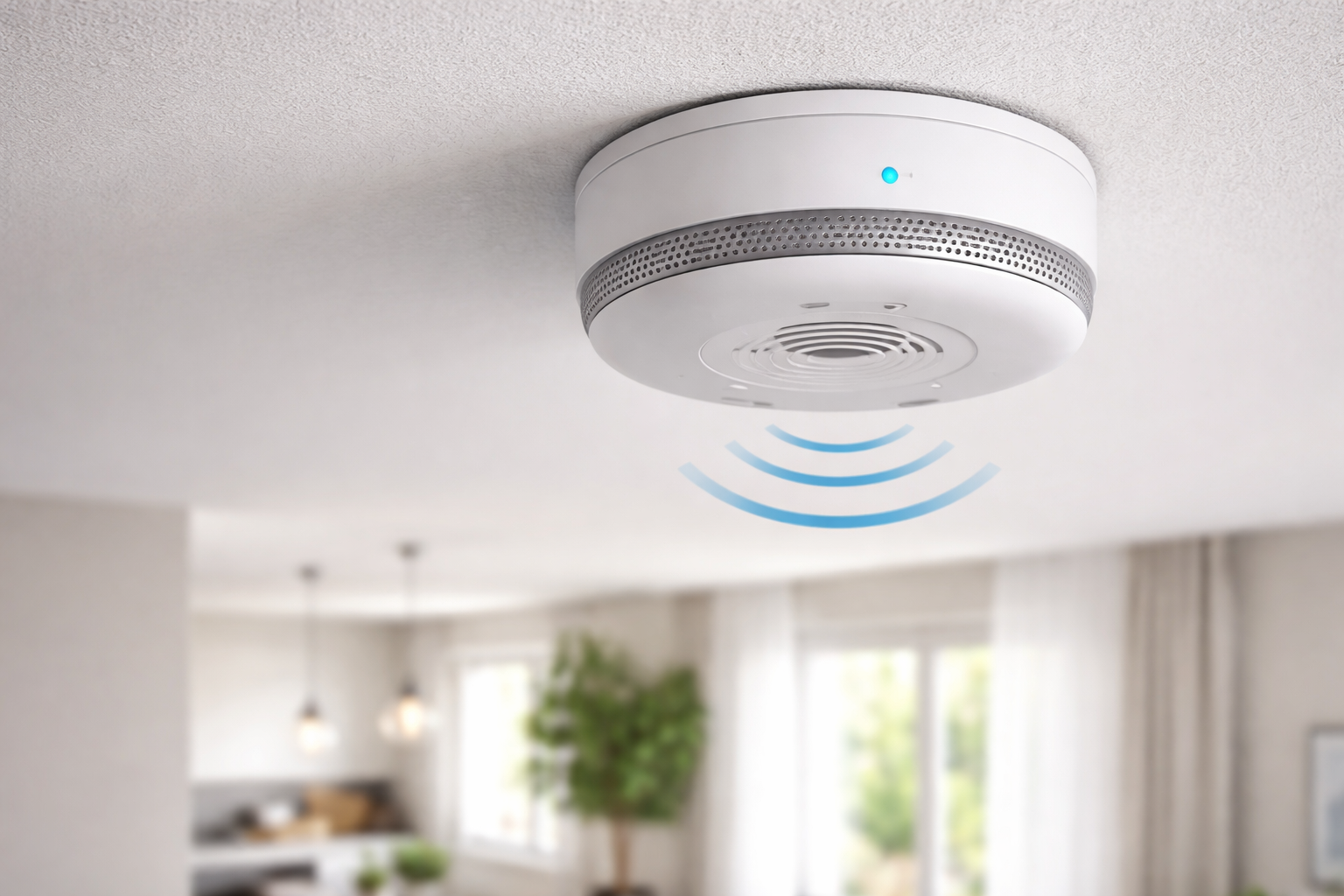
Why smoke detectors chirp (low battery, end of life, night cold), how to stop it safely, what 3 vs 4 beeps mean, and when to replace smoke and CO alarms. This guide sums up the criteria that matter, the mistakes to avoid and the concrete choices that help you decide faster.
It’s almost always 2 or 3 a.m. One short, high-pitched chirp. Silence. Then, just as you drift off, another. Someone ends up on a chair with a broom handle — and in too many homes I’ve walked through, the “fix” ends with the battery on the kitchen counter and an alarm on the ceiling that will never sound again.
In fifteen years assessing homes, an empty battery compartment is the smoke alarm failure I run into most, and the national data agrees. In NFPA’s analysis of 2018–2022 home fires where smoke alarms were present but failed to operate, a missing or disconnected battery was the leading reason (35% of those fires), and dead batteries accounted for another 24%.
The good news: a single chirp is a maintenance message, not an emergency — it almost always means the battery is low or the alarm has reached the end of its life. Here’s how to tell which, how to stop it safely, and when the only right answer is a new alarm.
The quick answer: what that chirp means
A single chirp every 30 to 60 seconds means the battery is low: replace it with the type your manual specifies, then press the test button. If the chirp continues after a fresh battery, or the unit is a sealed 10-year alarm, it has reached end of life and the whole alarm must be replaced. A loud, repeating pattern of three beeps means smoke or fire; four beeps means carbon monoxide — get out and call 911. Under NFPA guidance, every smoke alarm should be replaced 10 years after the manufacture date printed on it.
Still setting up your alarms? Start with where to place smoke detectors — a unit in the wrong spot chirps and false-alarms more than it should.
Decode the sound: chirp, alarm, or something else?
NFPA advises learning the sounds of your own alarms from the user guide (or by searching the brand and model online), because exact patterns vary by manufacturer. The main categories are consistent, though.
A single chirp every 30–60 seconds: low battery
NFPA’s guidance is direct: one chirp every 30 or 60 seconds is the low-battery signal — change the battery. Kidde says its smoke alarms chirp every 30–40 seconds (every 60 seconds on some models) for at least seven days once the battery runs low. Google’s Nest Protect chirps once every 60 seconds, pulses its ring yellow and announces that the batteries are low.
A chirp that won’t stop after a new battery: end of life
Sensors wear out. Per NFPA, if a new battery doesn’t stop the chirping, the alarm has reached end of life and needs replacing. The signal varies by brand:
- Kidde sealed-battery smoke alarms chirp every 30 seconds when it’s time to replace them.
- Nest Protect (2nd gen) gives two chirps every 60 seconds, a yellow ring and a spoken “expired” message — with warnings a few months ahead.
- Other brands use double chirps, LED flash codes or a display message. Your manual is the authority.
Three loud beeps, repeating: smoke or fire
A continuing set of three loud beeps is the evacuation signal. It isn’t a chirp and it isn’t something to troubleshoot: get out, call 911, stay out.
Four loud beeps, repeating: carbon monoxide
Four loud beeps signal carbon monoxide — Kidde describes four short beeps, five seconds of silence, then four again. Get everyone to fresh air outside and call 911.
Hearing something else — say, a chirp between red LED flashes, which Kidde uses as a malfunction signal? Check the manual or contact the manufacturer.
Why smoke alarms chirp at night
It isn’t bad luck. Kidde explains that a battery nearing the end of its life develops internal resistance, and a drop in room temperature increases that resistance. Homes are usually coldest overnight, so a weak battery crosses the low-battery threshold in the small hours — and the chirp may stop once the house warms a few degrees. First Alert says the same: cold slows the battery’s chemistry and drops its voltage.
So a chirp that “went away by lunchtime” is not fixed — it’s a dying battery that will chirp again tonight. And cold spaces are the wrong place for a smoke alarm anyway: NFPA advises against installing them where temperatures drop below 40°F (4.4°C) or rise above 100°F (38°C).
How to stop a chirping smoke detector — safely
The goal is to stop the noise without leaving a room unprotected:
- Confirm it’s a chirp, not an alarm. A short chirp with long silences is maintenance; repeating loud beeps mean get out.
- Identify the unit and its type. Stand under each alarm until you find the one chirping. No battery door means a sealed 10-year unit — the chirp is end of life, so skip to replacement.
- Check the date on the back. Twist the alarm off its bracket. More than 10 years past the manufacture date, or no date at all? NFPA says replace it — don’t waste a battery.
- Fit a fresh battery of the exact type the manual lists. 9-volt, AA and lithium aren’t interchangeable (Nest Protect, for instance, calls for Energizer Ultimate Lithium AA). Check polarity and close the battery door fully.
- Drain residual charge if it still chirps. First Alert’s reset: battery out, hold Test/Silence for 15–20 seconds, reinstall, test. On a hardwired unit, switch off the breaker first and follow the manual. Never work on wiring with the power on.
- Clean out the dust. Kidde recommends gently vacuuming the openings with a soft brush attachment (or short bursts of compressed air) at least twice a year — no water or sprays. In NFPA’s data, lack of cleaning explained 8% of fires where alarms didn’t operate.
- Press the test button. Replace any alarm that doesn’t sound.
- Still chirping? Replace the alarm. A chirp that survives a new battery and a reset is the end-of-life signal.
Need sleep first? Some newer alarms let the hush button silence a low-battery chirp temporarily — Kidde says up to 12 hours on newer units. That’s a legitimate stopgap. Pulling the battery is not: NFPA says never to remove batteries or disable a smoke or CO alarm, and the U.S. Fire Administration calls it a potentially deadly mistake.
Chirping symptoms at a glance
| What you hear / see | Likely cause | What to do |
|---|---|---|
| One chirp every 30–60 s (replaceable battery) | Low battery | New battery of the type in the manual, then test |
| Chirp continues after a new battery | End of life, or residual charge | Reset (test button 15–20 s, battery out); if it persists, replace |
| Sealed 10-year unit chirping | End of life | Replace the whole alarm |
| Chirps at night, quiet by afternoon | Weak battery + cooler night air | Replace the battery the same day |
| Hardwired alarm chirping | Backup battery low, power interruption | New backup battery, reset per manual; electrician if it persists |
| Nest Protect: 2 chirps every 60 s | Expired | Replace the Protect |
| Full alarm with no smoke | Dust, insects, steam or cooking | Clean per manual; move away from kitchen/bathroom |
| 3 loud beeps, repeating | Smoke or fire | Get out, call 911, stay out |
| 4 loud beeps, repeating | Carbon monoxide | Fresh air outside, call 911 |
| CO alarm chirps every 30 s after 7–10 years | CO sensor end of life | Replace now — it may no longer detect CO |
Is your alarm due for replacement?
Grab a chair — question 1 needs the date on the back.
🔋 Keep, fix or replace?
4 quick questions about the alarm that's chirping (or the oldest one in the house).
1. What does the manufacture date on the back say?
2. When did the battery last get attention?
3. How often do you press the test button?
4. Is it chirping right now?
Hardwired alarms chirp too
A hardwired alarm carries a backup battery for outages, and it still runs down — the U.S. Fire Administration says to replace it at least once a year. Kidde adds that, rarely, a loose wire in the connector causes intermittent chirping. If a new backup battery and a breaker-off reset don’t fix it, check the date (hardwired units age out on the same 10-year clock) and leave any wiring to an electrician. Choosing a replacement? See hardwired vs. battery smoke detectors.
When to replace: the 10-year rule (and CO alarms)
Smoke alarms: 10 years from the date of manufacture. NFPA 72, the national fire alarm code, says smoke alarms in one- and two-family homes shall not remain in service more than 10 years from the manufacture date — not the installation date. NFPA explains why: sensors wear out and may take longer to detect a fire. Replace sooner if the alarm gives an end-of-life warning or fails a test.
CO alarms: typically 7–10 years, model-dependent. NFPA says to replace a CO alarm per the manufacturer’s instructions or when its end-of-life signal sounds. Kidde rates its CO alarms at seven or ten years depending on the model; at end of life they chirp every 30 seconds, a new battery won’t stop it, and the unit can no longer detect carbon monoxide. Google rates the Nest Protect (2nd gen) at 10 years from manufacture. Combination smoke + CO units follow the manufacturer’s date. For where a new CO alarm belongs, see where to place a carbon monoxide detector.
How to find the manufacture date
- Back or side label. Twist the alarm off its bracket; a flashlight helps.
- No date? NFPA’s guidance: replace it.
- Nest Protect: the app shows a “Replace by” date in the device’s technical info; it’s also on the back.
- Next time: write the replace-by year on the base with a marker.
Monthly testing: the 30-second habit
NFPA recommends testing smoke and CO alarms at least once a month with the test button, and changing replaceable batteries at least once a year (Kidde suggests twice). Sealed 10-year units skip the battery chore entirely — and there’s no battery to borrow for the TV remote.
Prefer phone alerts and a voice that tells you which room is chirping? Read our hands-on Google Nest Protect review, or compare options in our best smoke detectors guide. Every smoke and CO guide lives in the smoke detectors hub.
Get a free assessment within 24 hours from a licensed pro near you — alarms, detectors, entry points. No obligation, zero spam.
Conclusion
A chirping smoke detector is annoying by design. One chirp every 30–60 seconds: change the battery. Still chirping after a fresh battery, or a sealed unit chirping: replace the alarm. Three or four loud beeps: get out and call 911. Check the manufacture date on every alarm, replace smoke alarms at 10 years and CO alarms when the manufacturer says, and test monthly. Above all, never answer a chirp by removing the battery — that’s how a two-minute job becomes a home with no warning at all.
Frequently Asked Questions
Why does my smoke detector chirp every 30 seconds?
With a replaceable battery, a single chirp every 30 to 60 seconds means the battery is low — replace it and test. On a sealed 10-year unit, or if the chirp survives a fresh battery, it’s usually the end-of-life signal (Kidde’s sealed alarms chirp every 30 seconds when it’s time to replace them).
Why is my smoke alarm still chirping after I changed the battery?
Usually the battery door isn’t fully closed, the battery is the wrong type, the alarm is holding residual charge, or it has reached end of life. Reseat the correct battery, then reset (First Alert: hold Test/Silence 15–20 seconds with the battery out). If it still chirps, NFPA says replace the alarm.
Why does my smoke detector only chirp at night?
Because the house is colder. Kidde explains that a weak battery’s internal resistance rises as the room cools, so the low-battery chirp starts in the coldest hours and may stop once the house warms. The battery is still failing — replace it the same day.
Can I just take the battery out to stop the chirping?
No. NFPA says never to remove batteries or disable a smoke or CO alarm, and missing or disconnected batteries are the leading reason alarms fail in real fires. If you need quiet until morning, use the hush button where your model offers it, then fix the problem the same day.
How do I know how old my smoke detector is?
Twist it off the bracket and find the date of manufacture on the back or side label. Count 10 years from that date, not from installation. If there’s no date, NFPA says replace it. Nest Protect also shows a “Replace by” date in the app.
How long do carbon monoxide detectors last?
Typically 7 to 10 years depending on the model — Kidde rates its CO alarms at seven or ten years, Google the Nest Protect (2nd gen) at 10. At end of life a CO alarm chirps in a pattern a new battery won’t stop; replace it immediately, because it may no longer detect carbon monoxide.
Sources
- NFPA — Learn the sounds of your smoke and CO alarms (tip sheet) — chirps vs. 3-beep and 4-beep alarms.
- NFPA — Educational Messages Desk Reference (2026 edition) — 10-year replacement, manufacture date, monthly testing, CO alarm replacement.
- NFPA — Smoke Alarms in US Home Fires (June 2024) — why alarms fail in real fires.
- Kidde — What causes consistent chirping? — low-battery, end-of-life, hush and malfunction patterns.
- Kidde — Why do smoke alarms chirp in the middle of the night? — battery resistance and temperature.
- Kidde — When should I replace my alarms? — smoke and CO alarm service life.
- First Alert — How to reset smoke or CO alarms — reset steps, battery and hardwired.
- Google Nest Help — Nest Protect lights and sounds — low-battery and expiration signals.
