

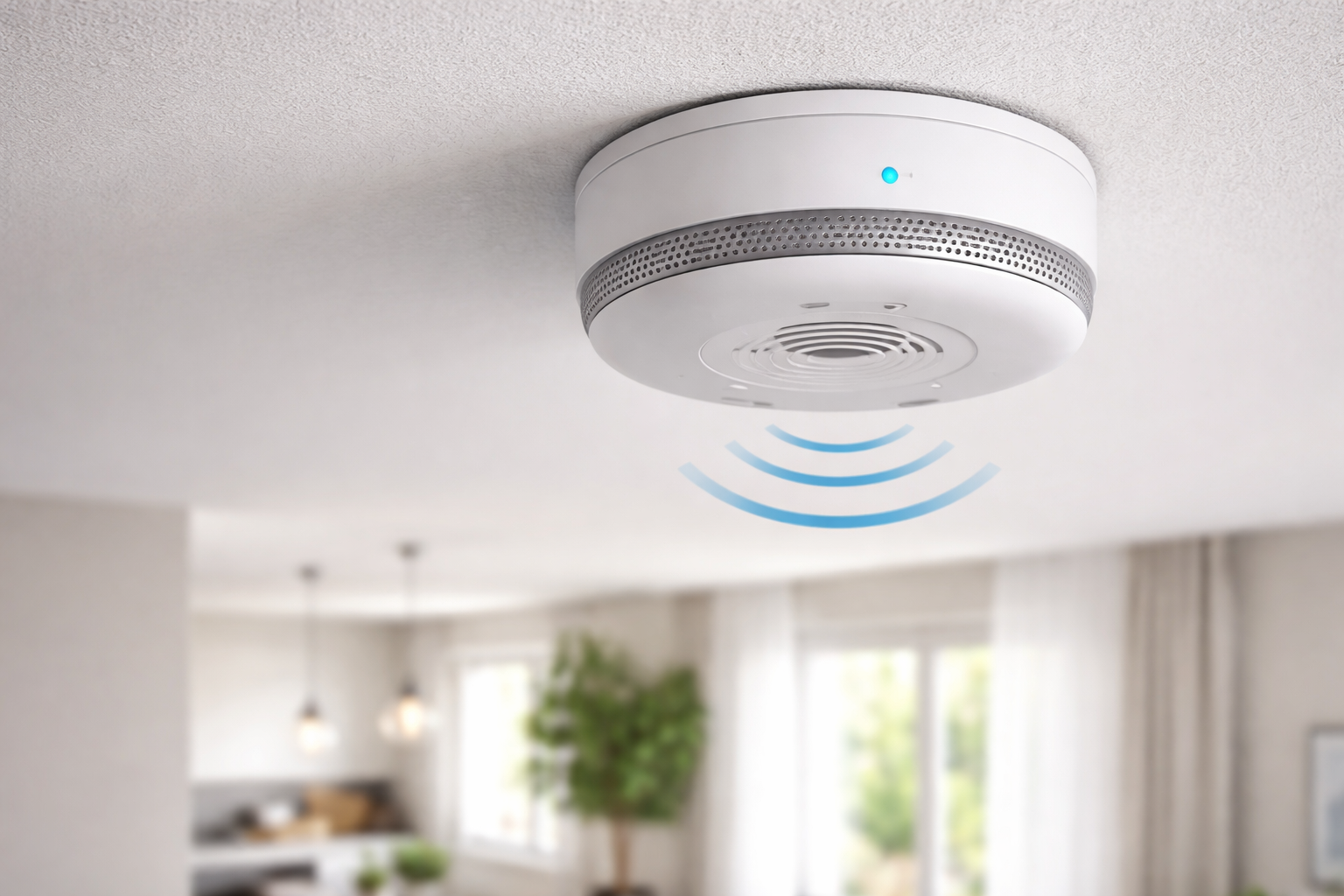
Where CO detectors go — outside sleeping areas, every level, near the garage door — how high to mount them, how far from appliances, and where never to put one. This guide sums up the criteria that matter, the mistakes to avoid and the concrete choices that help you decide faster.
In fifteen years assessing homes, the CO alarm I find most often is in the wrong place: plugged in a foot from the furnace, sitting in the garage, or tucked behind a couch at floor level “because the gas sinks.” None of those spots does the one job a CO alarm has: wake the people who are asleep, early enough for them to get out.
According to the CDC, more than 400 Americans die every year from unintentional carbon monoxide poisoning not linked to fires, and more than 100,000 end up in an emergency department. CO has no color, smell or taste — the alarm is your only warning. Planning smoke alarms too? Pair this with our smoke detector placement guide — the rules overlap, but aren’t the same.
The quick answer: where a carbon monoxide detector goes
Install a CO alarm in a central location outside each separate sleeping area and on every level of the home, as NFPA and the U.S. Consumer Product Safety Commission (CPSC) recommend. Add one inside any bedroom that has a fuel-burning appliance in it or its attached bathroom, and one inside the house near the door to an attached garage. Mount it at the height the manufacturer specifies — CO mixes with room air, so it doesn’t need to go near the floor — and keep it out of kitchens, bathrooms, garages and furnace rooms, at the clearance from fuel-burning appliances given in your manual (published figures range from 5 to 15 feet by brand). Choose an alarm listed to UL 2034 and interconnect your alarms if you can.
Where to install carbon monoxide detectors
Outside every sleeping area — the location everyone agrees on
Your first CO alarm goes in the hallway outside the bedrooms. NFPA calls for CO alarms “in a central location outside each sleeping area,” CPSC says the same, and the model International Residential Code (IRC, section R315) — adopted, often with amendments, by many states and cities — requires them in new homes “outside of each separate sleeping area in the immediate vicinity of the bedrooms.”
The reason is physiology: the CDC notes that people who are sleeping or intoxicated can die from CO before they notice any symptoms. Two refinements:
- Separate sleeping areas need separate alarms. A primary suite at one end of the house and the kids’ rooms at the other are two areas.
- A fuel-burning appliance in a bedroom moves the alarm inside. Under the IRC, if one sits in a bedroom or its attached bathroom, the CO alarm goes in that bedroom. First Alert and Kidde also suggest an alarm in each bedroom as added protection.
On every level of the home
CPSC and NFPA both recommend a CO alarm on every level; EPA spells it out as “every level of the home’s livable space (including the basement).” One nuance: CPSC advises against attics or basements unless they include a sleeping area, and manufacturers rule out unheated attics and crawl spaces, which fall outside the alarm’s operating range (40–100 °F on the First Alert and Kidde manuals we checked). A finished, lived-in basement gets an alarm; an unheated attic doesn’t.
Inside the house by the attached-garage door
EPA recommends a CO alarm “inside the home near the door leading to the attached garage and in rooms over the garage” — and the IRC requires CO alarms in new homes with an attached garage that opens into the house, even with no gas appliance. Note the word inside: the garage itself is a poor spot for a residential alarm. And CPSC’s rule stands regardless: never leave a car running in an attached garage, even with the door open.
Interconnect them
NFPA: “For the best protection, interconnect all CO alarms throughout the home.” The 2021 IRC requires it in new construction when more than one CO alarm is needed, and accepts listed wireless alarms. Wired or battery? Our hardwired vs. battery smoke detectors guide covers trade-offs that apply to CO alarms too.
How high should a CO detector be mounted?
The most persistent myth: “CO is heavier than air, so the alarm goes near the floor.” It isn’t. Google’s Nest help center tackles it directly — “carbon monoxide is slightly lighter than air and diffuses evenly throughout the room.” What the authorities actually say:
- NFPA: “Follow the manufacturer’s instructions for placement and mounting height.”
- CPSC: CO alarms “may be installed into a plug-in receptacle or high on the wall.”
- Combination smoke + CO alarms follow the smoke rules — ceiling or high on a wall — because smoke rises and the CO sensor works fine up there.
A plug-in at outlet height, a wall unit where the instructions say, or a combo on the ceiling are all correct. What’s wrong is any spot air can’t reach — CPSC warns against locations “that can be covered by furniture or draperies.”
How far from furnaces, water heaters and bathrooms?
There’s no single legal distance, and manufacturers don’t agree — which is why the manual for your alarm is the rule. What the sources we checked say:
- First Alert (SMCO210V manual): at least 15 ft (4.6 m) from the furnace or fuel-burning heat source where possible — closer “will not harm the Alarm, but may increase the frequency of unwanted Alarms” — and 10 ft (3 m) from showers, humidifiers, laundry rooms and other high-humidity sources.
- Kidde (KN-COPE-IC manual): at least 5 ft from any fuel-burning or cooking appliance; 3 ft from bathroom doors with a tub or shower, supply ducts and ceiling fans.
- Google Nest help and EPA: not within 15 ft of heating or cooking appliances / fuel-burning appliances.
- CPSC: not in kitchens, not above fuel-burning appliances, not near heating vents.
The numbers differ, the principle doesn’t: far enough that normal startup emissions don’t trigger it, away from steam. In a small home where 15 feet is impossible, First Alert says to go as far from the fuel-burning source as you can.
Where NOT to put a carbon monoxide detector — room by room
Bad placement means nuisance alarms, and a nuisance alarm gets unplugged. Use this table as your checklist:
| Location | Install a CO alarm? | Why |
|---|---|---|
| Hallway outside the bedrooms | ✅ Yes — top priority | NFPA, CPSC and IRC R315 all start here; sleepers can't notice symptoms |
| Every level, incl. a finished basement | ✅ Yes | CPSC, NFPA and EPA recommend one per level of living space |
| Bedroom with a fuel-burning appliance | ✅ Yes, inside the bedroom | IRC requirement when the appliance is in the bedroom or its bathroom |
| Other bedrooms | 👍 Recommended extra | Manufacturers suggest it, especially if doors stay closed |
| Inside the house by the garage door / room above garage | ✅ Yes | EPA guidance; vehicle exhaust is a classic CO source |
| Inside the garage | ❌ No | Exhaust, dust and temperatures outside most units' 40–100 °F range |
| Kitchen / right above the furnace or water heater | ❌ No | CPSC advises against; startup emissions cause nuisance alarms |
| Furnace or utility room | ❌ No | Kidde lists furnace rooms as do-not-install; same startup problem |
| Bathroom, laundry room | ❌ No | Humidity; manuals ask for 3–10 ft of clearance from showers |
| Unfinished attic or crawl space | ❌ No | Outside operating temperature; CPSC: not unless someone sleeps there |
| Behind furniture or drapes, near vents, fans or open windows | ❌ No | Blocked or moving air keeps CO from reaching the sensor |
| Ceiling peak, direct sunlight | ❌ No | Dead air and heat — both listed as avoid in the manuals |
Score your home’s CO coverage
🚨 Is your home covered against carbon monoxide?
4 quick questions. An honest score beats a false sense of safety.
1. Is there a working CO alarm outside every sleeping area?
2. Is there a CO alarm on every level of the home?
3. Where is the alarm closest to your furnace or water heater?
4. Do you test your CO alarms and know when they expire?
Combination smoke + CO alarm, or separate units?
Both work: the IRC explicitly permits combination smoke/CO alarms in place of separate CO alarms. A combo should carry both listings — UL 217 (smoke) and UL 2034 (CO). The real risk is not knowing which one you have: UL Standards & Engagement reports that nearly 3 in 10 U.S. adults wrongly believe a smoke alarm means they don’t need a separate CO alarm. A smoke-only alarm does not detect carbon monoxide — check the label.
A combo means fewer devices and one interconnection — ideal for the bedroom hallway — but it follows smoke-alarm placement (ceiling, away from the kitchen) and is replaced as a whole unit. Separate plug-in CO alarms give more placement freedom, and many show the CO level on a display. Smart combos add phone alerts when you’re away — see our Google Nest Protect review or our best smoke detectors guide.
Look for the UL 2034 listing
CPSC recommends a CO alarm that meets the current UL 2034 standard, the U.S. standard for residential CO alarms published by UL Standards & Engagement. Two consequences:
It’s designed not to sound at trace levels. Per the UL 2034 alarm points quoted in First Alert’s manual, an alarm must sound within 4–15 minutes at 400 ppm, 10–50 minutes at 150 ppm and 60–240 minutes at 70 ppm, and is designed not to alarm at a constant 30 ppm for 30 days. So a quiet alarm doesn’t rule out CO: if anyone has symptoms, act on the symptoms.
It tells you when it’s worn out. UL 2034 requires an end-of-life signal distinct from the alarm sound. The CDC says to replace CO detectors according to the manufacturer’s instructions or every 5 years; NFPA and CPSC say to test them monthly. Not sure what a chirp means? See our guide to chirping alarms and when to replace them.
Do you legally need a CO detector? (U.S. state laws)
There’s no single national rule. Requirements come from state laws, adopted building and fire codes and local ordinances, and they differ on which homes are covered (new construction, rentals, sales, homes with fuel-burning appliances or attached garages). The model IRC requires UL 2034-listed CO alarms in new homes with fuel-fired appliances or attached garages, but states and localities can adopt, amend or reject it. UL Standards & Engagement’s 2025 state-by-state assessment put 13 states in its lowest tier, where “statewide regulations are limited or absent,” and noted Missouri has no statewide CO alarm requirement. Check with your local fire or building department, and treat the code as the minimum.
What to do when a CO alarm sounds
Safety first, diagnosis later. Per CPSC and NFPA:
- Get everyone out to fresh air immediately. Don’t try to find the source.
- Call 911 (or your fire department) from outside.
- Do a head count — make sure everyone is accounted for.
- Don’t go back in until emergency responders say it’s safe.
- Don’t use a faulty appliance again until a qualified technician has serviced it.
A short “trouble” chirp is different: NFPA says check and replace the battery, and if the signal continues, call the fire department.
Know the symptoms. The CDC lists headache, dizziness, weakness, upset stomach, vomiting, chest pain and confusion — often described as “flu-like.” CPSC’s clue: early CO poisoning resembles the flu, but without the fever. Infants, older adults and people with heart disease, anemia or breathing problems are more vulnerable. If anyone has these symptoms, get out and call 911 — whether or not an alarm is sounding.
Get a free assessment within 24 hours from a licensed pro near you — alarms, detectors, entry points. No obligation, zero spam.
Conclusion
CO alarm placement comes down to one principle: protect the people, not the appliance. One alarm in a central spot outside each sleeping area, one on every level, one inside the house by the attached-garage door — interconnected and listed to UL 2034. Mount them at the height the manufacturer specifies, keep them out of kitchens, bathrooms, garages and furnace rooms at the clearance your manual gives, test monthly and replace on schedule. And if one ever sounds: everyone out, call 911, don’t go back in. For everything else on smoke and CO protection, start from our smoke & CO detectors hub.
Frequently Asked Questions
Where is the best place to put a carbon monoxide detector?
In a central spot in the hallway outside the bedrooms — where NFPA, CPSC and the International Residential Code all start, because sleeping people can be overcome before noticing symptoms. Then add one on every level and one inside the house by the attached-garage door.
Does a CO detector need to be installed low, near the floor?
No — that’s a myth. Carbon monoxide is slightly lighter than air and mixes evenly through a room. Mount the alarm at the height its manufacturer specifies; CPSC notes CO alarms can go in a plug-in outlet or high on the wall, and combination alarms go on the ceiling like any smoke alarm.
How far should a CO detector be from a furnace or gas water heater?
Follow your alarm’s manual, because brands differ: Kidde says at least 5 feet from any fuel-burning or cooking appliance; First Alert, EPA and Google’s Nest guidance say 15 feet. Closer placement mainly causes nuisance alarms.
Should I put a carbon monoxide detector in the garage?
Usually not — most residential CO alarms are rated for 40–100 °F, and garages bring exhaust and temperature swings. EPA recommends one inside the house near the door to the attached garage, and in any room above it.
Is a combination smoke and CO detector as good as separate units?
Yes, if it’s listed to both UL 217 (smoke) and UL 2034 (CO) — the IRC accepts combination alarms in place of separate CO alarms. Just don’t mistake a smoke-only alarm for one that detects CO.
What should I do if my carbon monoxide alarm goes off?
Get everyone out to fresh air immediately, call 911 from outside, and account for everyone. Don’t look for the source, and don’t go back in until responders say it’s safe.
Sources
- NFPA — Carbon monoxide safety — placement, interconnection, testing and what to do when a CO alarm sounds.
- CPSC — Carbon Monoxide Fact Sheet and CPSC — CO Alarms — every level and outside sleeping areas, UL 2034, locations to avoid, emergency steps.
- CDC — Carbon monoxide poisoning basics — U.S. deaths and ER visits, symptoms, detector replacement.
- EPA — Carbon monoxide alarms infographic — garage-door and above-garage placement, distance from fuel-burning appliances.
- UL Standards & Engagement — U.S. State CO Risk Assessment Report (2025) and Safety Standards for CO-Detecting Devices — state requirement gaps, IRC summary, UL 2034 scope and end-of-life signal.
- 2021 IRC Section R315 summary — Anne Arundel County, MD — where CO alarms are required, location, combination alarms, interconnection.
- Google Nest Help — Learn about carbon monoxide — the low-mounting myth, distance from heating and cooking appliances.
- Manufacturer manuals: First Alert SMCO210V and Kidde KN-COPE-IC — distances, where not to install, operating temperature, UL 2034 alarm points.
